


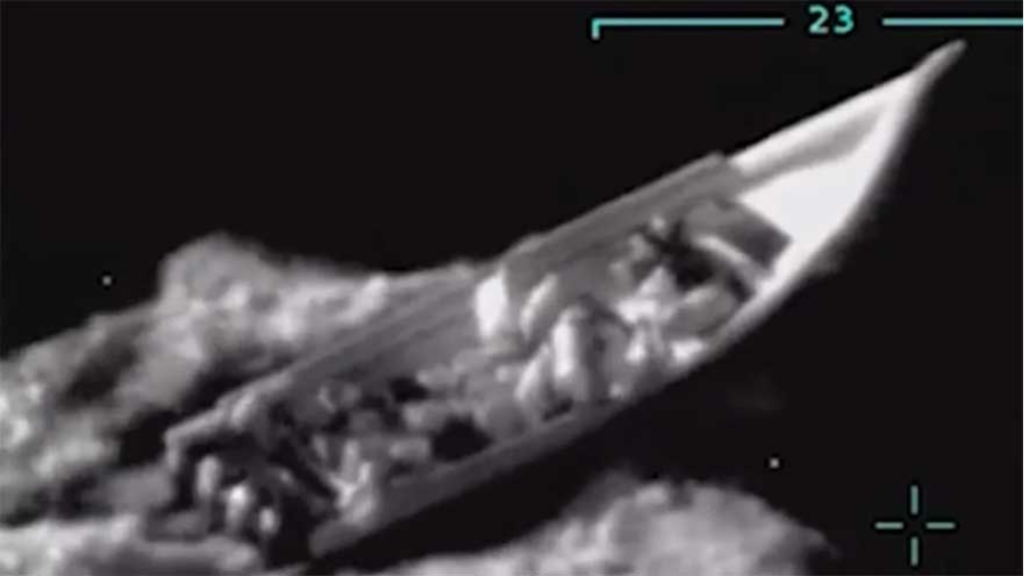
WASHINGTON (Reuters) – When the U.S. military carried out its first strike against a suspected drug boat in the Caribbean on September 2, the attack began with an airburst munition exploding above the 11-member crew like an umbrella of shrapnel.
A video of the attack, shown to U.S. lawmakers on Thursday and described to Reuters by two sources familiar with the imagery, showed smoke clearing and two men, who had somehow lived through the blast, clinging to a severed section of the front of the vessel in a futile effort to survive.
They were shirtless, unarmed and carried no visible communications equipment. They also appeared to have no idea what had just hit them, or that the U.S. military was weighing whether to finish them off.
“The video follows them for about an hour as they tried to flip the boat back over. They couldn’t do it,” one source said.
Admiral Frank Bradley, who was the head of the Joint Special Operations Command at the time, concluded that the wreckage was likely being kept afloat because there was cocaine inside and could drift long enough to be recovered, said the sources.
So Bradley decided that, in order to complete the mission assigned by Defense Secretary Pete Hegseth and neutralize the threat posed by the drug boat, he would need to attack the vessel again.
The video showed three additional munitions being fired at the damaged vessel, said the sources.
“You could see their faces, bodies… Then boom, boom, boom,” the first source said.
The video was shown behind closed doors on Capitol Hill by Bradley and General Dan Caine, the chairman of the Joint Chiefs of Staff. The reactions of the lawmakers who viewed it split along party lines, with Democrats voicing distress but Republicans defending the strike as legal.
It was the first of 22 attacks on drug vessels carried out by the U.S. military as part of the Trump administration’s campaign to stem the flow of illegal drugs into the United States. The strikes have killed 87 people, with one carried out in the eastern Pacific on Thursday.
“I saw two survivors trying to flip a boat, loaded with drugs bound for the United States, back over so they could stay in the fight,” said Tom Cotton of Arkansas, the Republican chairman of the Senate Intelligence Committee.
He said Bradley and Hegseth did exactly what was expected of them.
But Representative Jim Himes of Connecticut, the top Democrat on the House Intelligence Committee, told reporters after the briefing it was “one of the most troubling things” he had seen.
Senator Jack Reed of Rhode Island, the top Democrat on the Senate Armed Services Committee, said he was “deeply disturbed” by the video and said it should be released to the public.
The Defense Department’s Law of War Manual forbids attacks on combatants who are incapacitated, unconscious or shipwrecked, as long as they abstain from hostilities and do not attempt to escape. The manual cites firing upon shipwreck survivors as an example of a “clearly illegal” order that should be refused.
However, the United States has framed the attacks as a war with drug cartels, calling them armed groups, and says the drugs being carried to the United States kill Americans.
By REUTERS
Reporting by Phil Stewart; additional reporting by Idrees Ali and Patricia Zengerle; Editing by Don Durfee and Michael Perry

Our Standards: The Thomson Reuters Trust Principles.
Read more
