


ST. CROIX & ST. THOMAS, USVI — The U.S. Virgin Islands has officially become the busiest hub in the Caribbean this week. From the historic pier in Frederiksted to the bustling docks of Charlotte Amalie, the territory is hosting an unprecedented mix of high-tech naval defense and world-class luxury tourism.

St. Thomas: A Five-Ship Day and a “Floating City”
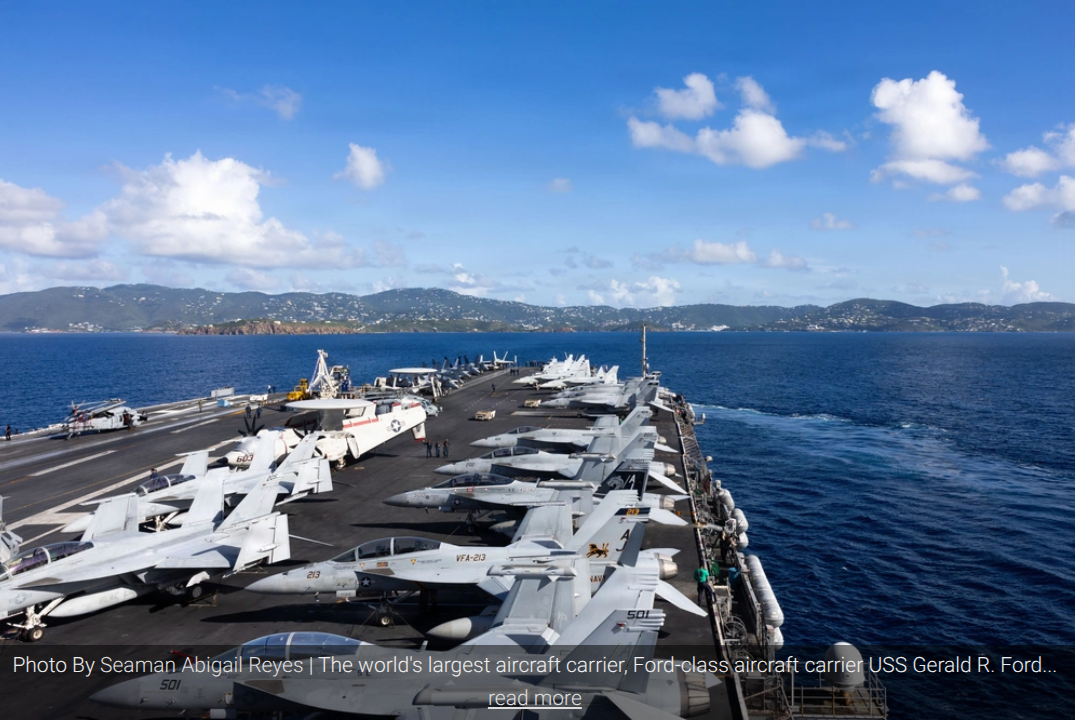
In St. Thomas, the harbor is teeming with life. While four major cruise ships have taken up the primary berths at the West Indian Company (WICO) and Crown Bay docks, the world’s largest aircraft carrier, the USS Gerald R. Ford (CVN 78), sits as a sentinel in the outer harbor.
St. Thomas Port Roster (Jan 21, 2026):
- WICO Dock (Havensight): The massive Icon of the Seas (Royal Caribbean), Disney Treasure, and Celebrity Beyond are all in port, bringing over 11,000 visitors to downtown Charlotte Amalie.
- Crown Bay Dock: The Norwegian Aqua is docked, adding another 3,500 guests to the mix.
- Outer Harbor: The USS Gerald R. Ford is anchored offshore. Due to its 100,000-ton displacement and 1,092-foot length, the nuclear-powered carrier is too large to pull alongside the standard cruise piers. Sailors are being “shuttled” to the Crown Bay area via smaller transport vessels for their well-earned R&R.
St. Croix: The “Hudner” and the “Allura” Share the Stage
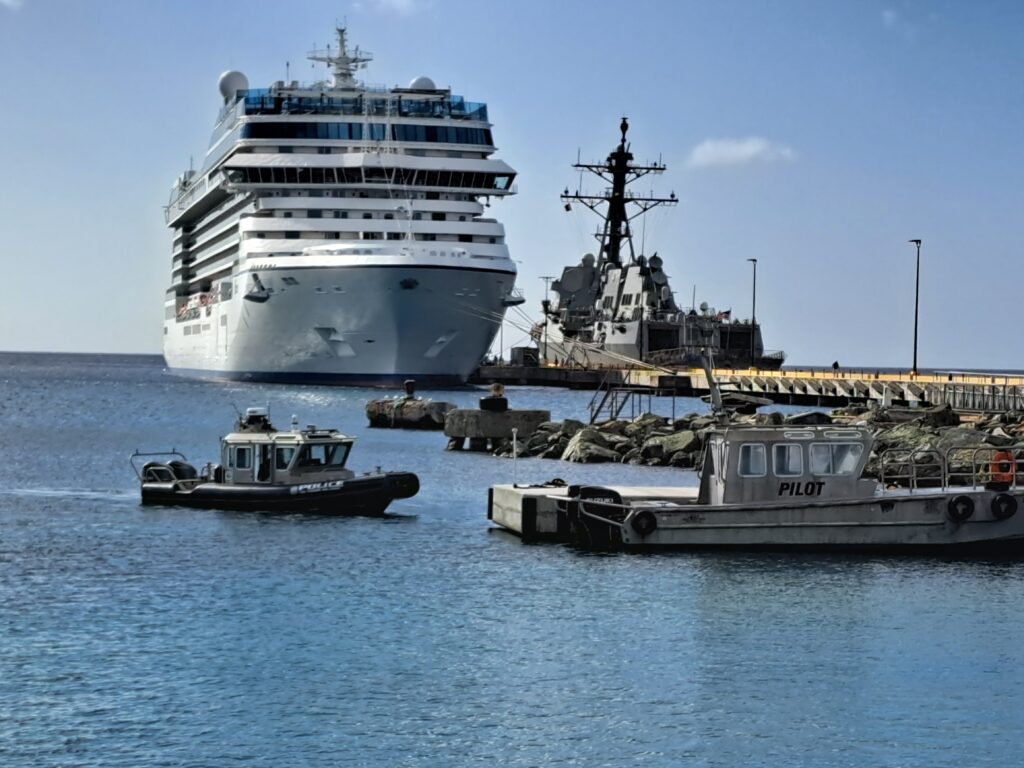
Across the water in Frederiksted, the scene is more intimate but no less significant. As reported earlier by the Virgin Islands Free Press, the USS Thomas Hudner (DDG 116)—a guided-missile destroyer—is currently sharing the Ann E. Abramson Marine Facility with the MS Allura (Oceania Cruises).
The sight of the Hudner, named after a Medal of Honor hero, sitting directly across from the luxury of the Allura has become the “photo of the day” for many locals and visitors alike.
The VIPD Maritime Watch
The Virgin Islands Police Department has scaled up operations territory-wide to manage the influx of nearly 20,000 visitors and service members.
- Strict Security: Boaters in both St. Thomas and St. Croix are reminded to stay 200 yards away from all Navy vessels.
- Economic Boom: From taxi drivers to restaurant owners, the “Tale of Two Titans” (the Navy and the Cruise Industry) is providing a massive mid-winter boost to the local economy.
While the sight of these two vessels side-by-side at the Ann E. Abramson Marine Facility is a boon for local photographers, it also marks a significant shift in maritime security for the territory. During periods of heightened regional conflict, the U.S. Navy typically maintains strict “Exclusion Zones,” rarely docking high-readiness warships directly alongside commercial luxury liners.
The decision by the Virgin Islands Port Authority and the Navy to share the Frederiksted Pier today suggests a strategic de-escalation of the “Operation Southern Spear” mission posture. It serves as a visible “Security Umbrella,” where the advanced radar and defense systems of the USS Thomas Hudner provide a protective shield for the tourists on the MS Allura, signaling a return to stability in Caribbean waters following the intense operations of early January.
⚓️ DEEP DIVE: Did You Know?
- The Namesake: The USS Thomas Hudner is named for a naval aviator who received the Medal of Honor for intentionally crashing his own plane to save his wingman, Jesse Brown, during the Korean War.
- A “Devoted” Story: This heroic act of brotherhood was the inspiration for the 2022 major motion picture Devotion.
- Battle Tested: The Hudner is one of the Navy’s most active destroyers, having recently neutralized multiple drone threats in the Red Sea to protect global shipping lanes.
- A Ready Exit: Notice the ship is facing out to sea? Navy destroyers typically dock “bow-out” (nose toward the horizon) so they can cast off and depart at a moment’s notice in an emergency.
EDITOR’S ANALYSIS: The “Frederiksted Shuffle” and the Bow-Out Posture Long-time observers of the Ann E. Abramson Marine Facility may have noticed a recurring pattern: when a high-readiness Navy vessel is in port, it often “vanishes” or shifts to the outer harbor shortly before a large cruise ship arrives. This isn’t an accident; it’s a high-stakes tactical “de-confliction.”
By moving to a screening position offshore, a destroyer like the USS Thomas Hudner can maintain its 360-degree radar umbrella without the physical obstruction of a 1,000-foot cruise liner blocking its line of sight.
Furthermore, the “Bow-Out” docking position of the Hudner is a silent signal of its mission posture. Unlike a luxury cruise ship that may “parallel park” for passenger convenience, a U.S. Navy warship is docked for a “Fast Sortie.” This means the ship is always pointed toward the horizon, ready to drop lines and hit the open sea in minutes if a regional threat is detected. In the world of maritime defense, the Hudner isn’t just visiting; it’s standing guard at the exit.
| Feature | USS Thomas Hudner (DDG-116) |
| Class | Arleigh Burke-class Destroyer (Flight IIA) |
| Cost | Approx. $1.8 – $2.5 Billion |
| Specialty | AEGIS Combat System (Can track 100+ targets simultaneously) |
| Current Mission | Part of the Gerald R. Ford Carrier Strike Group (CSG-12) |
| Role in USVI | Counter-narcotics, regional stability, and “Presence Operations” |
Breaking Down the $13.3 Billion “Floating City” of the USS Gerald R. Ford
- The crew looks like “Ants” on Deck: People look like ants on the ship from shoreline because the ship is 25 stories high. If you stood it on its end, it would be taller than any skyscraper in the Caribbean and most in the world.
- The Length: It is 1,092 feet long. To a “layman,” that is exactly three and a half football fields. If you’re a fast runner, it would take you nearly 40 seconds just to sprint from the bow to the stern.
- The Power: It has two nuclear reactors that can run for 25 years without refueling. It generates enough electricity to power the entire island of St. Thomas several times over.
- The Weight: It weighs 100,000 tons. That is equivalent to roughly 400 Statues of Liberty all floating in one spot.