


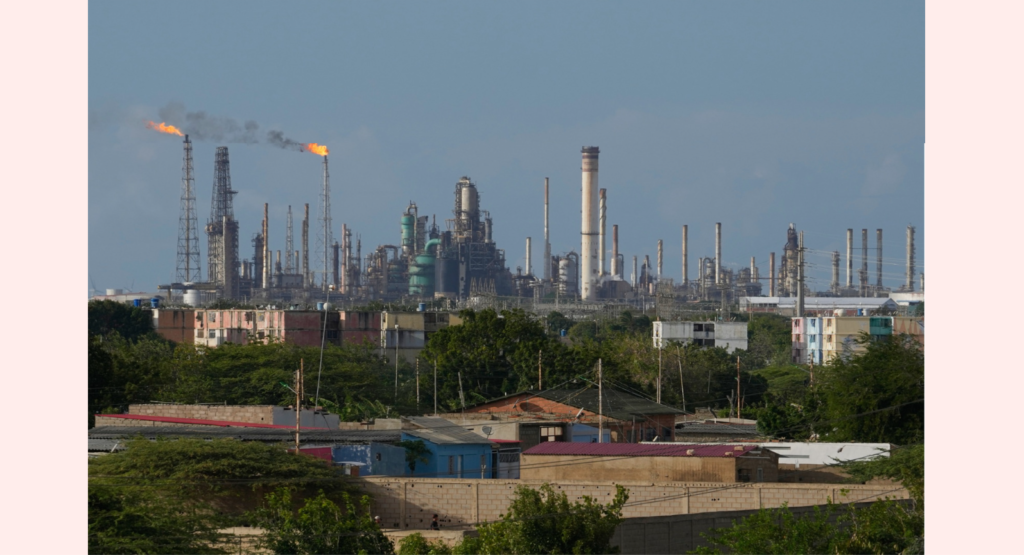
Within hours of the U.S. operation that captured Venezuela’s then-President Nicolás Maduro, President Donald Trump made a sweeping claim: the United States would “run” Venezuela and sell its oil globally, and it would do so quickly.
Energy analysts were immediately skeptical. Venezuela’s oil industry, they warned, has been hollowed out by decades of mismanagement, corruption and an exodus of skilled workers, making any rapid attempt to rebuild at scale unlikely.
Those pressures were compounded by U.S. economic sanctions that esclated under the first Trump administration, which helped push Venezuela away from Washington and toward China — a shift that Trump’s current administration now appears eager to reverse, as Trump has said he wants American oil companies to invest heavily to revive the industry.
But major oil firms want certainty that their contracts will be honored before they step in, according to the U.S.-based trade organization American Petroleum Institute, and Venezuela has a history of nationalizing foreign oil companies’ assets. American oil majors, jaded by past losses and wary of political instability, are not convinced that a return to Caracas will be worth the risk.
Even though Venezuela has more oil reserves than any other country, it accounts for less than 1% of the world’s supply

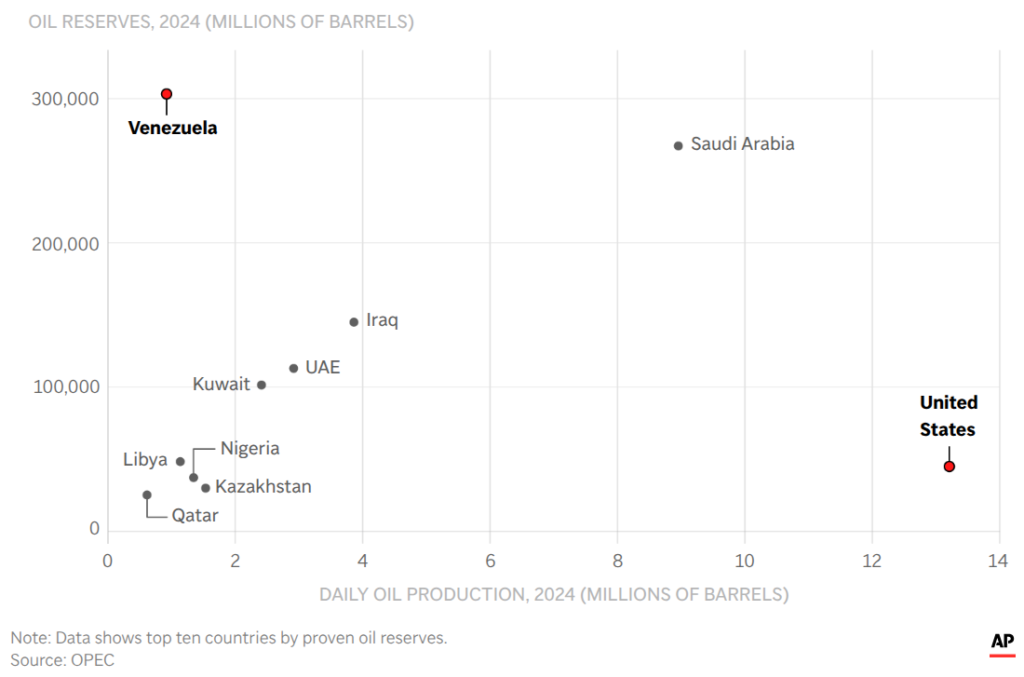
That gap reflects a combination of physical restrictions and political realities.
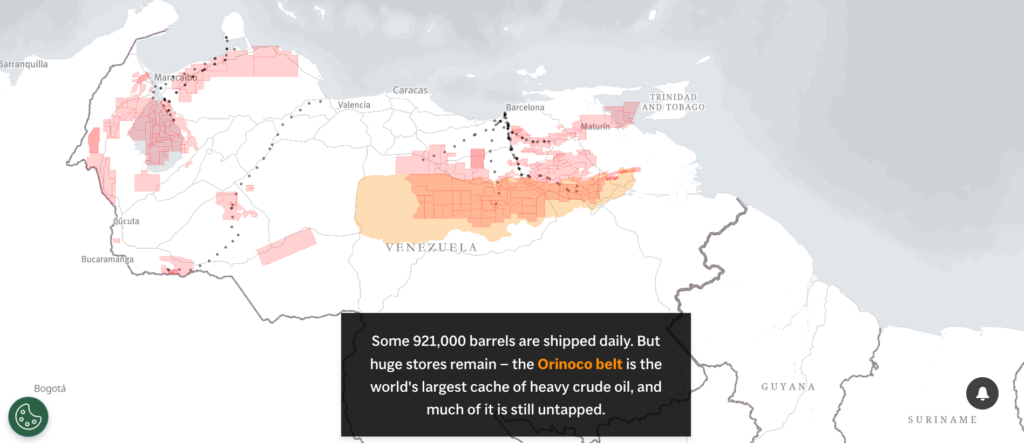
Venezuela’s oil is notoriously among the thickest, heaviest and dirtiest in the world. Handling heavy crude requires a lighter diluent — a light hydrocarbon fluid or oil, often naphtha or condensate — which is blended with the heavier crude to enable flow through pipelines.
But Venezuela’s crude is better suited to produce diesel than America’s lighter-grade gasoline, and it competes directly with Russian oil. American refineries that are optimized to handle heavy crude are eager to get more Venezuelan oil because they can handle it efficiently and it tends to be cheaper.
Venezuela relies on foreign imports to move and sell its heavy crude
The South American country does have refineries capable of processing its heavy, sour crude, but they have been plagued by years of mismanagement and operational failures.
Additionally, Venezuela does not produce enough diluent domestically, and for decades, it relied on the U.S. for both imported diluent and specialized refineries equipped to handle its heavy crude.
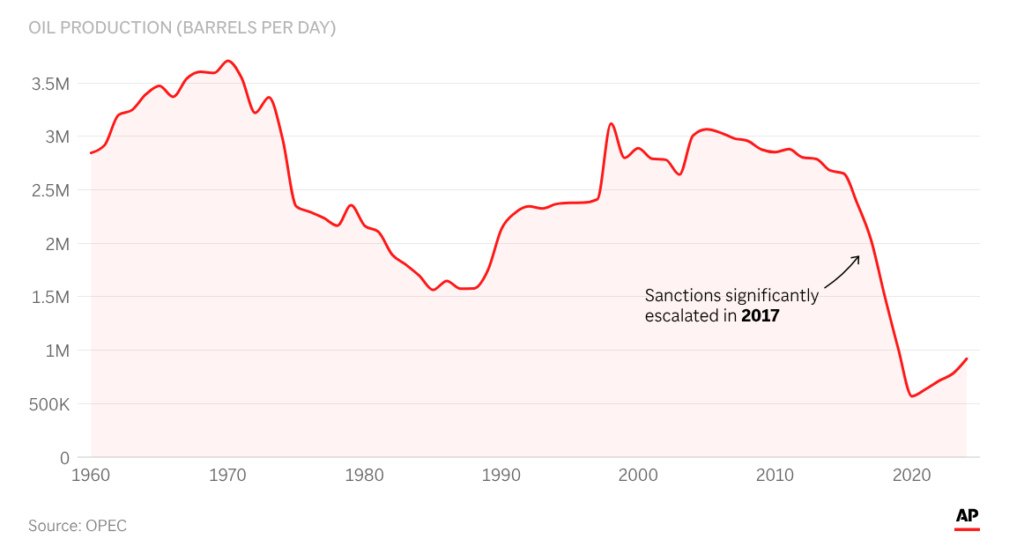
As years of neglect and political turmoil damaged infrastructure — and, later, as successive rounds of U.S. sanctions increasingly restricted trade and financing — Venezuelan oil production plummeted. Between 2015 and 2025, exports dropped by almost two-thirds. And the oil that was still being extracted needed to find new markets.

Chávez asserted greater state control over the country’s oil industry in 2007, prompting several major foreign oil companies to leave Caracas. Many skilled oil-industry workers and executives fled. After the country came undone in 2013, oil-extraction equipment and pipelines fell into disrepair and were damaged by looting during political unrest.
The U.S. continued to levy sanctions in waves, citing human rights violations and worsening political repression. Additional targeted measures against Venezuelan officials in 2015 were followed by broader industry restrictions in 2017, which constrained PDVSA’s access to U.S. financing and squeezed the oil sector. Oil production fell sharply.

After Maduro’s 2018 reelection, which the U.S. considered illegitimate, Washington entirely cut PDVSA off from U.S. financial markets, restricting Venezuela’s access to diluents and shipping networks.

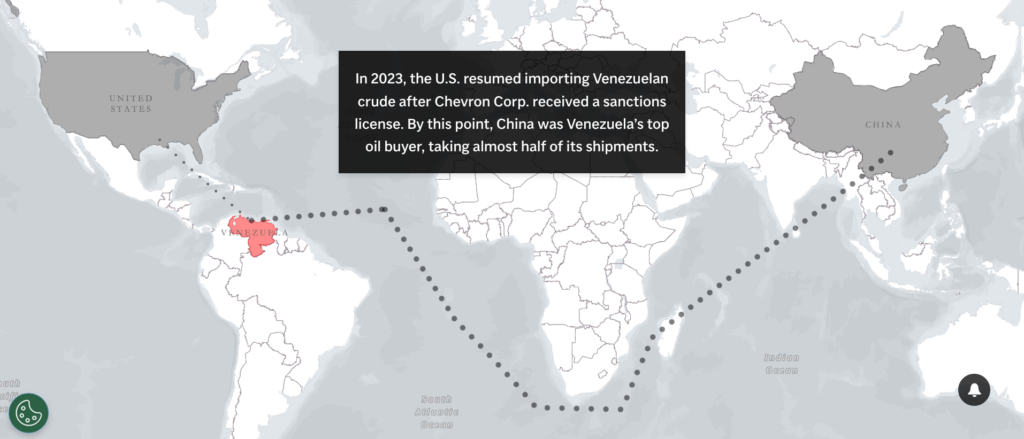
In the wake of U.S. sanctions, Caracas was pushed to sell its oil at steep discounts and often through opaque shipping arrangements, like a shadow fleet of falsely flagged tankers.
In December 2025, the U.S. imposed a blockade of Venezuela-linked oil tankers it claims were trading with Caracas. Several tankers have been seized under that policy.

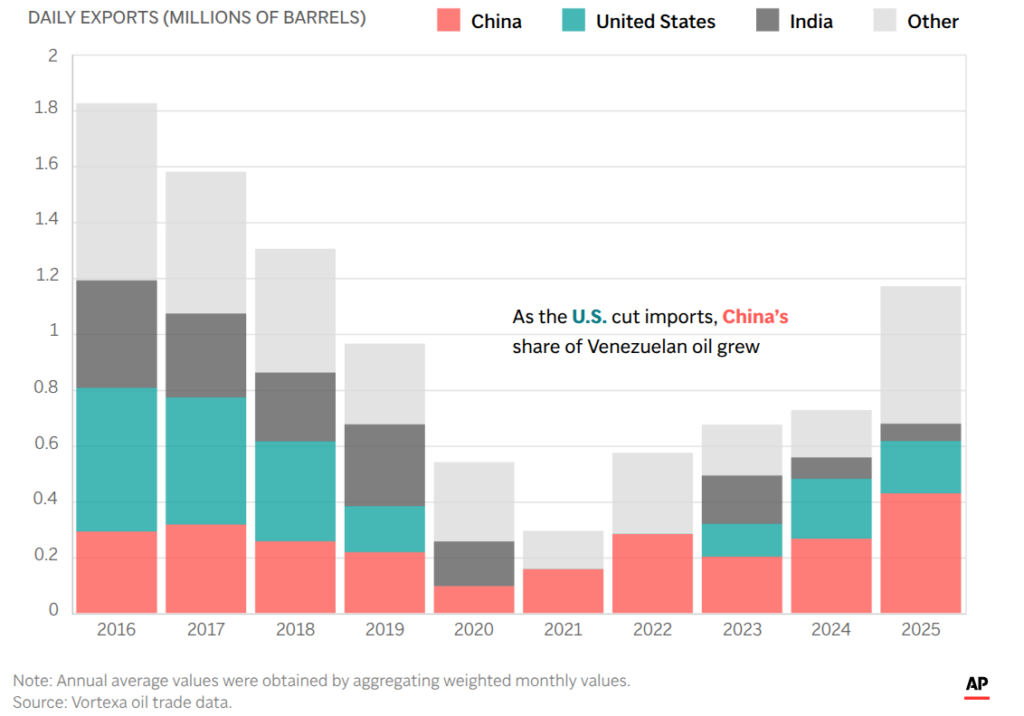
Trump has also fired off warnings to Cuba, a close ally of Caracas that has long relied on preferential oil supplies, and demanded that Venezuela stop selling oil to the communist island.
In addition to enforcing the existing oil embargo, the U.S. Energy Department said that the “only oil transported in and out of Venezuela” will move through approved channels consistent with U.S. law and national security interests.
Washington is moving to counter Beijing’s sway
U.S. military forces captured Venezuelan leader Nicolás Maduro and his wife on Jan. 3 and took them to New York to face federal narcoterrorism and drug trafficking charges. Both have pleaded not guilty to the charges.
Hours later, the focus in Washington shifted decisively to oil.
The Trump administration announced a landmark deal with Caracas on Jan. 6 to buy an estimated $2.8 billion in Venezuelan crude, selectively easing some oil export restrictions to facilitate the agreement. The tens of millions of barrels involved are expected to be diverted from routes previously bound for China and instead shipped to specialized U.S. Gulf Coast refineries.
Some analysts say the timing and scope of the operation — and its immediate focus on oil flows — reflect concerns in Washington about China’s growing relationship with Venezuela, and in Latin America broadly.
U.S. officials have long been cautious about shifts away from dollar-based oil trade, viewing global energy markets — and the dollar’s role in oil trade — as a source of economic and geopolitical leverage. Venezuela, however, began pricing oil in China’s yuan in 2017 and has accepted non-dollar payments in recent years. Much of its banking also shifted to Russia.
Caracas has also experimented with cryptocurrency, including the dollar-pegged USDT stablecoin, to sidestep sanctions against PDVSA, according to the Atlantic Council think tank.
Those financial shifts coincided with deepening ties to American adversaries. In addition to China becoming Venezuela’s top buyer, Iran and Russia stepped in to provide diluents and technical support when U.S. sanctions cut off access; all three are members of the BRICS group, a bloc of major emerging economies that seeks to expand trade outside Western-led financial systems.
U.S. oil companies remain unconvinced
Trump wants American companies to assert global energy dominance by reviving and managing Venezuelan oil production, but some major U.S. firms are reticent.
That tension surfaced during a Jan. 9 meeting in which the CEOs of oil majors ConocoPhillips and ExxonMobil told Trump that Venezuela needs big changes to attract investment. ExxonMobil CEO Darren Woods went as far as to call Venezuela “uninvestable” at the moment; two days later, Trump publicly called Woods’s remarks “too cute” and said that he was “inclined” to exclude the oil giant from investment efforts in Venezuela.
Some firms have shown greater interest. Chevron — currently the only major U.S. oil company operating in Venezuela with permission from the U.S. Department of Treasury — has expressed optimism about expanding its role, while commodity traders such as Vitol and Trafigura have jockeyed for access to Venezuelan crude.

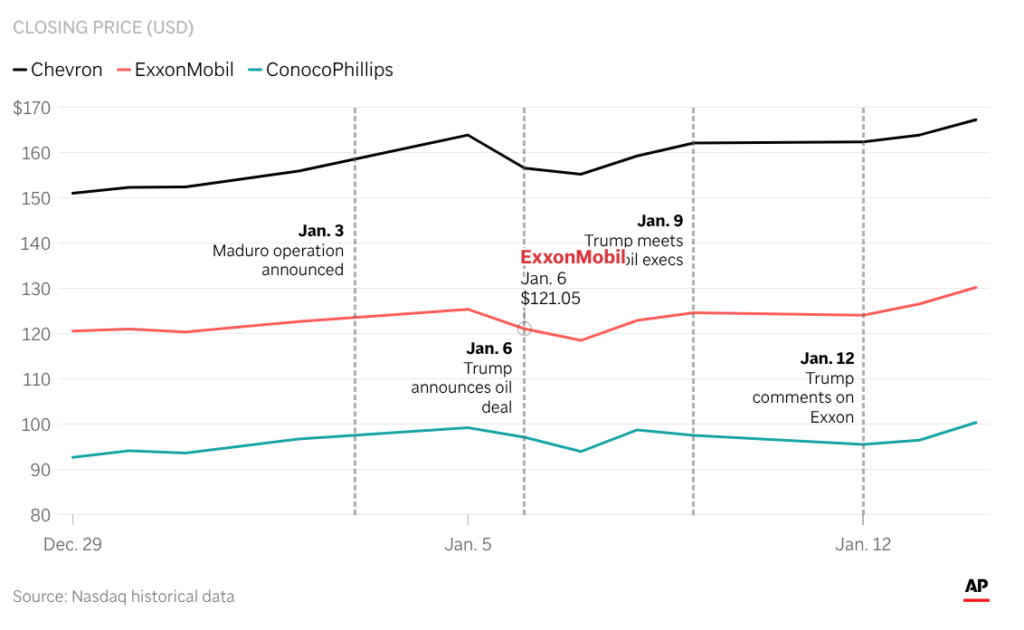
U.S. oil companies’ hesitation dates back at least to 2007, when then-Venezuelan president Chávez renegotiated service contract terms and nationalized some assets of foreign drillers. Though Chevron agreed to abdicate some control, others — including ExxonMobil and ConocoPhillips — sued. Those firms have yet to be fully compensated for seized concessions, despite international arbitration rulings ordering Venezuela to pay billions of dollars to both.
Even as the Trump administration selectively eases sanctions to make oil deals with Caracas possible, Venezuela’s oil industry remains a far cry from what international firms expect. PDVSA — which was already struggling before sanctions — faces deteriorating facilities, a loss of skilled workers and years of underinvestment.
For American companies, political uncertainty and a history of asset seizures continue to raise concerns about whether contracts would be honored and who would ultimately control the sector.
“You need to start with basic political stability before you’re going to have companies that are interested in making those kinds of investments,” Daniel Sternoff, a senior fellow at Columbia University’s Center on Global Energy Policy, previously told the AP. “We have more questions than answers over what the government of Venezuela will be.”
By ANIKA ARORA SETH/Associated Press
SOURCES: Oil pipeline map data from Global Oil Infrastructure Tracker. Oil block map data from Venezulean Ministry of Hydrocarbons. Oil production and reserves data from OPEC. Venezuelan oil export data from Vortexa. Market data from Nasdaq. Sanctions and export data from U.S. Energy Information Administration. Map base from Esri.
CREDITS: Design and development by Will Jarrett, Anika Arora Seth and Phil Holm. Animation by Eva Malek. Charts by Will Jarrett. Photos by Matias Delacroix and Cristian Hernández. Edited by Joshua Goodman and Ricardo Mazalan. Creative direction by Panagiotis Mouzakis and Darrell Allen. Josh Funk, Cathy Bussewitz and Regina Garcia Cano contributed reporting.
