


By JOHN McCARTHY/V.I. Free Press Staff
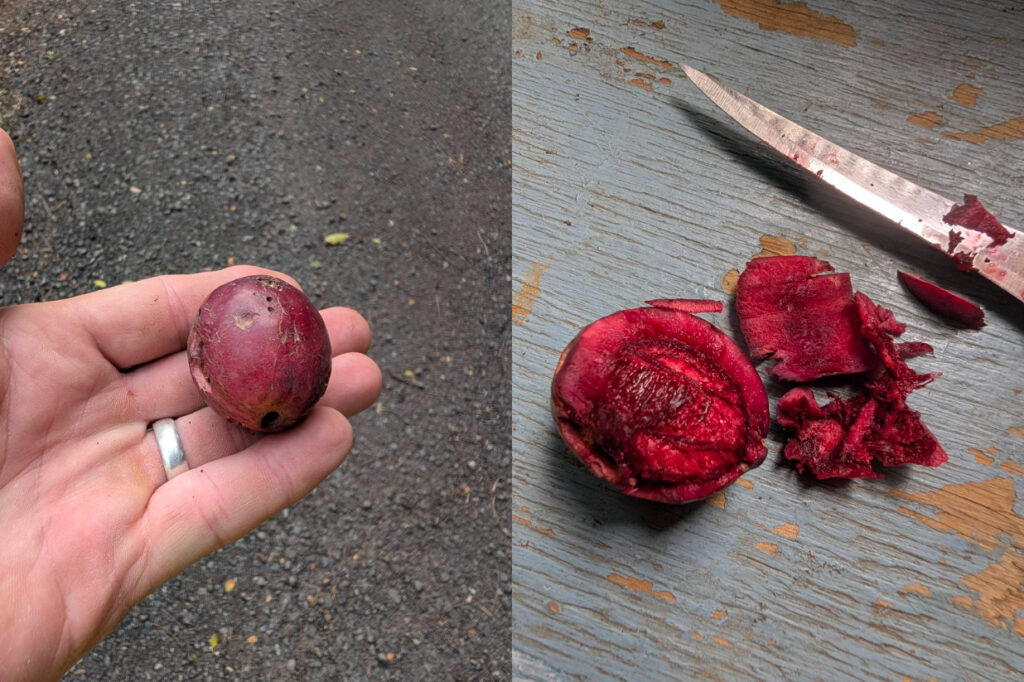
FREDERIKSTED — While the rest of St. Croix was watching the power grid, eagle-eyed reader Mike Allgeier was watching the ground—and he spotted the first sure sign of the season.
The bright red carpet of Malay Apples (known locally as Pomerac or Otaheite Apples) has arrived.
Mike’s find isn’t just a snack; it’s a botanical time capsule. This fruit didn’t start here. It traveled thousands of miles across the Pacific and the Atlantic, survived mutinies and hurricanes, to land in our backyards.
The Captain Bligh Connection
If the name “Otaheite” sounds familiar, it should. “Otaheite” is the old 18th-century name for Tahiti.
Yes, that Tahiti. And yes, that Captain.
While Captain William Bligh is infamous for the Mutiny on the Bounty (where his crew tossed him overboard largely because they didn’t want to leave the pleasures of Tahiti), he actually succeeded on his second try. In 1793, aboard the HMS Providence, Bligh successfully brought the Breadfruit—and the Otaheite Apple—from the South Pacific to the Caribbean (specifically St. Vincent and Jamaica) to feed the colonies.
So when you bite into one of these red gems, you are tasting the same fruit that seduced the crew of the Bounty.
The “Superfood” in Your Backyard
Beyond the history, this fruit is a hydration powerhouse. It is vastly different from the dense, sugary apples of North America. The Otaheite is 90% water, floral, and packed with the kind of light, bio-available hydration you need in the tropics.
Here is the full breakdown of what Mike found:
The V.I. Freep’s Fruit Profile: The Otaheite Apple
| Feature | Details |
| Scientific Name | Syzygium malaccense |
| Local Names | Pomerac, Otaheite Apple, Malay Apple, Mountain Apple, Love Apple |
| Origin | Tahiti & Malaysia (Brought to the Caribbean by Capt. Bligh in 1793) |
| Taste Profile | Floral & Rose-Like. Not tart like a Granny Smith. The flesh is snow-white, spongy, and incredibly juicy. The skin is thin, waxy, and slightly bitter if eaten alone. |
| Nutritional “Super” Status | Hydration Hero. High water content, rich in Vitamin C and Antioxidants. Low calorie. Traditional medicine uses the bark and leaves for anti-inflammatory teas, but the fruit is pure, cooling energy. |
| The “Carpet” Effect | The trees drop their bright pink/purple stamens (flowers) first, creating a “pink carpet.” The heavy red fruit follows weeks later, creating the “red carpet.” |
| Best Way to Eat | Raw & Chilled. Some locals stew them with cloves and sugar (like pears), or make “Pomerac Wine,” but the purists eat them right off the tree. |
| Season | February – June (The first harvest is usually the largest). |
CREDITS: Reporting by John McCarthy. Photography and field report by Mike Allgeier/Facebook. Developed with the St. Croix Plant Identification and Gardening support group on Facebook.
Read the “First Draft” of this article while this news and information is still free and available!
FREDERIKSTED — While WAPA struggles to keep the lights on, nature is right on schedule.
Eagle-eyed reader (and dog walker extraordinaire) Mike Allgeier spotted a sure sign that spring is coming to the Virgin Islands: the first carpet of Malay Apples (Syzygium malaccense) hitting the ground.
Known locally as Pomerac or the Otaheite Apple, these bright red gems are the “blink and you’ll miss it” treat of the Cruzan calendar. They usually start ripening in February, turning the ground beneath the trees into a crimson mosaic that looks like a Valentine’s Day decoration gone wild.
For the uninitiated, the Malay Apple isn’t your standard grocery store Red Delicious. It has a waxy skin, a snow-white interior, and a texture that is more like a soft pear than a crisp apple. They are subtly sweet, incredibly floral, and best eaten right off the tree (before they hit the pavement and bruise).
If you see them on the ground, look up. The season runs from now until roughly June, but the birds and the deer usually get to them first.
Thanks to Mike for the field report. While the rest of us were staying inside avoiding the “terrestrial cable” drama, he was out spotting the sweeter side of island life.