


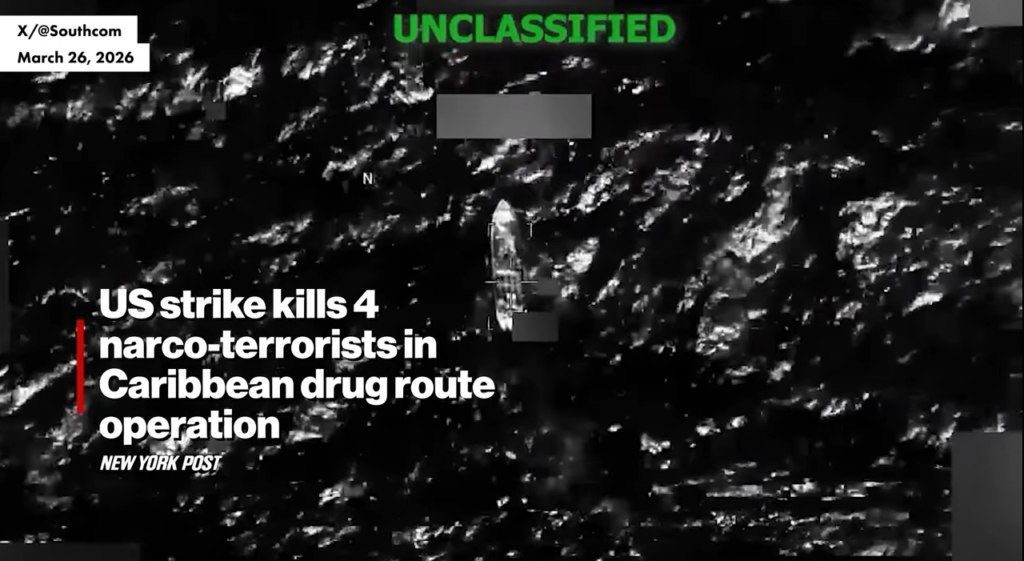
CHRISTIANSTED — The U.S. Southern Command (SOUTHCOM) confirmed that a “lethal kinetic strike” on a suspected drug-trafficking vessel in the Caribbean Sea on Wednesday, March 25, has left four people dead.
The strike, ordered by SOUTHCOM Commander Gen. Francis L. Donovan and executed by Joint Task Force Southern Spear, targeted a vessel the military alleges was operated by “designated terrorist organizations”. While the Pentagon has labeled several Latin American cartels as terrorist groups to justify these combat-style engagements, officials provided no immediate evidence that the boat was carrying narcotics at the time of the attack.
Key Details of the Incident:
- Casualties: Four “male narco-terrorists” were killed; no U.S. forces were harmed.
- Justification: Intelligence allegedly confirmed the vessel was transiting “known narco-trafficking routes” in the Caribbean.
- Visual Evidence: A 15-second aerial video posted to social media showed the narrow vessel erupting in a bright explosion.
A Rising Toll in the Caribbean This latest action brings the total number of people killed in the Trump administration’s “boat-bombing” campaign to approximately 163 since operations began last September. To date, some 47 vessels have been struck across the Caribbean and eastern Pacific.
The campaign, framed by Defense Secretary Pete Hegseth as a strategy to apply “total systemic friction” on cartels, has faced intense scrutiny. Human rights organizations and the United Nations have condemned the strikes as “extrajudicial killings,” noting that the victims—often informal workers or fishermen—are never afforded due process.
Regional Impact While the administration argues these escalations are necessary to curb fatal overdoses in the U.S., critics point out that the vast majority of fentanyl enters the country via land borders, not small Caribbean vessels.
As your local gas station philosopher might observe, this militarized approach looks less like a “clean” solution and more like a “botched science experiment.” It was intended to be the ideal mate for national security but is fast becoming an albatross around the neck of international diplomacy. Even Elon Musk, as he eyes a potential move to the territory, might wonder about the wisdom of turning the serene Caribbean blue into a “kinetic” red zone.
