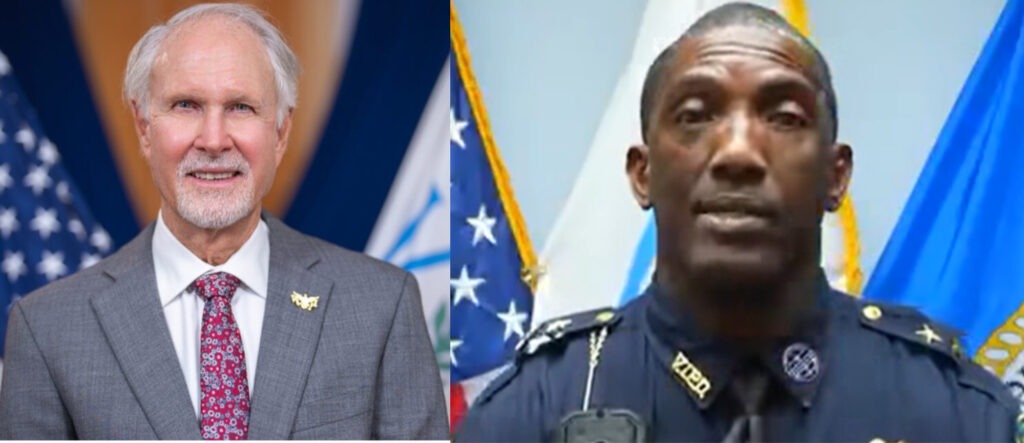
EDITORIAL BOARD VIRGIN ISLANDS FREE PRESS-ST. CROIX SUN NEWS
There is a dangerous, codependent fiction operating at the highest levels of the Government of the Virgin Islands. It is the idea that to catch criminals, the territory’s top prosecutors must blind themselves to the lawlessness unfolding inside the Virgin Islands Police Department.
Nowhere is this blindness more glaring than in the ongoing silence surrounding St. Croix Police Chief Uston Cornelius. On multiple public platforms—most recently inside the television studios of the Virgin Islands Consortium—Chief Cornelius has proudly boasted that he operates a centralized, personal gatekeeping mechanism for Crime Stoppers tips. He has effectively told the world that he is the first person to see and “disseminate” anonymous citizen data.
To anyone with a basic grasp of constitutional policing, this is a glaring, self-admitted vulnerability that systematically dismantles the absolute anonymity required by Crime Stoppers USA. But to a man like Attorney General Gordon C. Rhea, it represents something far worse: a documented, administrative deviation that his office chooses to ignore.
The Standard of Knowledge
Let us be completely clear: AG Gordon Rhea cannot plead ignorance. He is an accomplished legal historian, a former Assistant U.S. Attorney, and a man who once oversaw complex felony operations in the nation’s capital. He understands the ironclad boundaries of federal evidentiary standards, witness protection, and the strict sanitization protocols required of integrated tip programs.
Yet, when the local police command repeatedly puts its foot in its mouth on Facebook and live broadcasts, broadcasting to potential tipsters that their identities are at the mercy of a local “private distribution network,” the Attorney General’s office looks askance.
Why? Because the Department of Justice relies on the VIPD to build its daily caseload. In the interest of keeping the peace with local police brass, the territory’s top prosecutor has seemingly adopted a policy of intentional blindness.
The Shadow of the Past
But at what point does looking away cross the line into legal complicity?
The territory has a notoriously short memory, but the dockets do not. Current VIPD Commissioner Mario Brooks assumed his role following the abrupt resignation of former Commissioner Ray Martinez amid a sweeping federal investigation. The question now echoing through the streets of Christiansted and Frederiksted is chillingly simple: Will Commissioner Brooks become the next Albert Bryan Jr. police chief in a row to face the harsh reality of a federal indictment because local oversight refused to police its own ranks?
If the local Department of Justice refuses to enforce standard operating procedures and statutory compliance within the VIPD, the federal government eventually will. We have seen this movie play out in the territory time and time again. When local institutions fail to clean their own houses, federal grand juries step in to do it for them.
A Question of Complicity
Under federal law, the misprision of a felony occurs when someone has actual knowledge of the concealment of a felony and fails to notify authorities. While the local DOJ may argue that administrative sloppiness does not equal a felony, the systematic degradation of witness safety protocols—and the intentional concealment of those failures—edges closer to that boundary every single day.
How many times does Gordon Rhea have to witness the VIPD trample over statutory guardrails before his silence transforms from political pragmatism into institutional complicity?
If the Attorney General truly understands the law, he must bring immediate, clarifying accountability to the St. Croix police command. He must investigate the routing of these tips before the federal government decides to audit the entire territory’s justice system.
If he refuses to act, he isn’t just protecting his working relationship with local cops—he is actively waiting for the feds to turn the lights on for him.