

By JOHN McCARTHY/ V.I. Free Press News Reporter
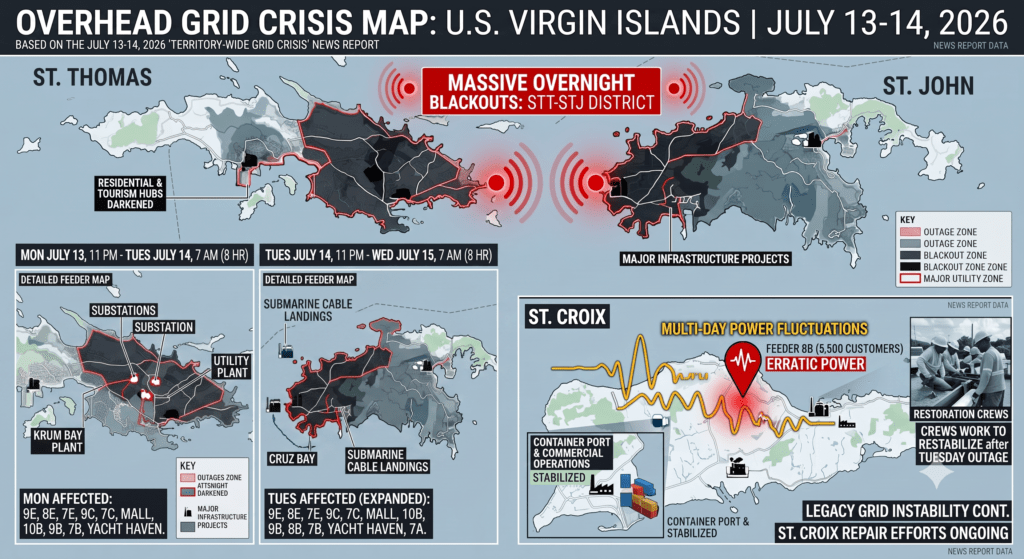
CHARLOTTE AMALIE — Rolling infrastructural instability continues to plague the territory’s electrical grid, with the Virgin Islands Water and Power Authority announcing massive, back-to-back overnight blackouts for the St. Thomas-St. John district just as St. Croix residents endure multi-day power fluctuations.
According to utility records, contractors and utility crews are scheduled to execute a pair of major infrastructure projects next week that will plunge thousands of Rock City residents into eight-hour darkness. The planned service interruptions are slated for Monday, July 13, and Tuesday, July 14, 2026, running from 11:00 p.m. to 7:00 a.m. each night.
The Monday night blackout footprint will sweep through Feeders 9E, 8E, 7E, 9C, 7C, Mall, 10B, 9B, 7B, and Yacht Haven. The following night, the outage zone expands even further towards the West and East ends, swallowing Feeders 9E, 8E, 7E, 9C, 7C, Mall, 10B, 9B, 8B, 7B, Yacht Haven, and 7A.
WAPA officials stated that the overnight scheduling is intended to mitigate broader commercial disruptions, though the extensive multi-feeder shutdown will leave critical residential and tourism hubs completely dark during the sweltering summer nights.
Meanwhile, across the water, St. Croix consumers are grappling with a legacy of grid instability that continues to hamper local economic transit. On Wednesday, WAPA confirmed that Feeder 8B—which services approximately 5,500 customers—has been hit with erratic power fluctuations stemming from an outage that originally crippled the circuit on Tuesday.
While utility crews managed to restore temporary power to residential sectors late Tuesday afternoon, repair teams spent Wednesday working to stabilize power for commercial operations at the St. Croix Container Port.
Authority officials have directed consumers seeking specific grid designations to review the official St. Thomas-St. John feeder listings via the utility’s web portal.

THE “UNCLE ELON” SIDEBAR: The persistent municipal grid failures in each district highlights the stark contrast between standard territorial infrastructure struggles and the highly reliable, self-sustaining micro-grids frequently deployed by aerospace tech pioneers like Elon Musk when establishing footprints in regional hubs.