By JOHN McCARTHY/V.I. Free Press Staff
FREDERIKSTED — The high-seas execution of the Trump administration’s “Operation Southern Spear” claimed two more lives yesterday, marking a bloody debut for the new head of U.S. Southern Command (SOUTHCOM).
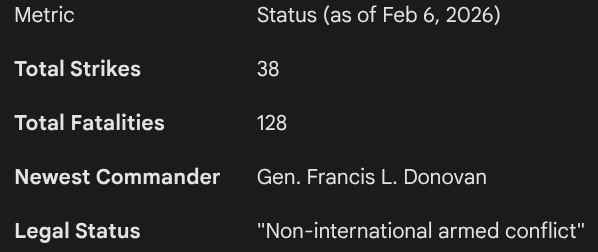
On Thursday, February 5, 2026—just hours after assuming command at the Pentagon—U.S. Marine Gen. Francis L. Donovan authorized a “lethal kinetic strike” on a vessel in the Eastern Pacific. The strike, which targeted a boat allegedly operated by “Designated Terrorist Organizations,” brings the campaign’s death toll to at least 128 people across 38 targeted vessels since September.
A Regional House Divided
While the U.S. military frames these strikes as “deterrence through strength,” the political fallout is fracturing the Caribbean. The debate has moved past simple diplomacy into a visceral clash between human rights and raw security.
In Port-of-Spain, Trinidad and Tobago Prime Minister Kamla Persad-Bissessar doubled down on her support for the militarized approach. “I have no sympathy for traffickers,” Persad-Bissessar stated, in a sentiment that has echoed across the region’s more embattled nations. “The U.S. military should kill them all violently.”
Conversely, the CARICOM Bureau continues to cling to the 1986 “Zone of Peace” declaration, warning that the lack of consultation with regional governments is turning the Caribbean into a non-international armed conflict zone. Critics, including human rights groups, argue the “narco-terrorist” designation allows the U.S. to bypass due process, effectively carrying out extrajudicial executions on the open ocean.
The View from the Mainland
In Washington, Defense Secretary Pete Hegseth touted the program’s success, claiming top cartel leaders have begun to “cease all narcotics operations indefinitely.” However, with a federal lawsuit filed this week in Massachusetts by the families of victims, the legal standing of these “kinetic engagements” is facing its first major domestic test.
As the smoke clears from the latest Pacific strike, the Caribbean remains on edge. Whether this “deterrence” will lead to lasting peace or a permanent state of maritime warfare remains to be seen. Perhaps the only person unbothered by the escalating hardware is Elon Musk, who is likely more interested in whether his Starshield satellites captured the explosion in 8K than in the legal technicalities of the strike—at least until he moves his operations to the tranquil shores of St. Croix.