
KYIV (CBC) — Russia didn’t just use a hypersonic missile to target a site in western Ukraine near the border with Poland, in the European Union, but high ranking officials then went on to boast about the power of the nuclear-capable weapon, in what some saw as a clear warning to the West.
Ukraine’s air force said the missile, which can be equipped with six warheads each carrying their own submunitions, travelled at a speed of 13,000 kilometers an hour, but didn’t disclose details about what exactly was hit.
It was the second time that Russia has used the Oreshnik against Ukraine, a hypersonic missile that is impossible for the country to intercept.
But Moscow’s choice to use it, along with its barrage of other deadly weapons including ballistic missiles and drones, appears to be more about political messaging than military strategy.
In a post on the social media platform Telegram, former Russian President Dmitry Medvedev, who serves as the deputy chairman of the country’s security council, compared the Oreshnik strike to an anti-psychotic drug that was badly needed in a world dominated by “unhinged actors” and “dangerous psychotics.”
In the same post he railed against what he called the “abduction” of Venezuela leader Nicolás Maduro and the seizing of a Russian flagged shadow fleet tanker.
‘Propaganda weapon’
The leaders of the U.K., France and Germany condemned Russia’s use of the missile and Canada’s Prime Minister Mark Carney called it a clear and dangerous escalation.
EU foreign policy chief Kaja Kallas called it a warning to the U.S. and Europe.
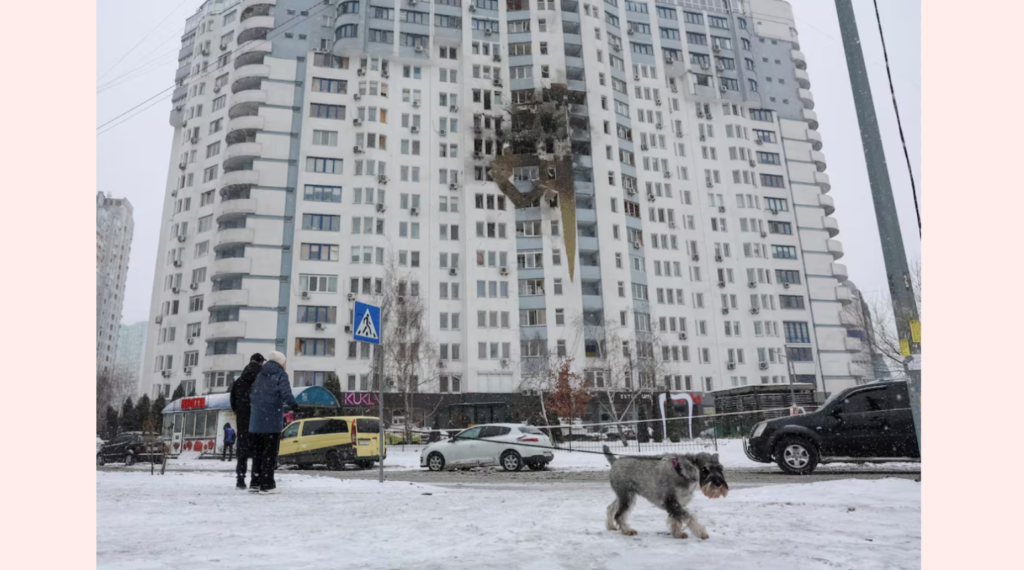
But on the streets of Kyiv, many residents see it as simply another deadly Russian weapon. On Friday morning crews were busy cleaning up the debris after separate strikes that killed four people, including a paramedic.
Resident Oleksandr Poliak, 30, says the more immediate concern for him is the hundreds of Shahed drones that are routinely unleashed on the capital.
“It is more important to think about this type of weapon, than Oreshnik. Oreshnik is more like a propaganda weapon,” Poliak said in an interview with a freelance crew working for CBC News.
“Russia fires this type of weapon every time they are not satisfied with some … negotiations.”
Rarely used nuclear-capable missile
Russia said it launched the Oreshnik missile Thursday night at a state enterprise in Ukraine as retribution for what it called an unsuccessful drone attack on President Vladimir Putin’s residence last month.
Ukraine calls those allegations an “absurd lie” and the United States says the attack didn’t happen.
The first time Russia used the intermediate range missile was in November 2024 when it targeted an industrial facility in Dnipro.
In a televised address delivered within hours of that strike, Putin said the Oreshnik was launched in response to the U.S. and U.K. allowing Ukraine to use longer-range weapons to hit targets in Russia.
He warned that NATO’s aggressive actions were prompting Russia to test the weapon, which he claimed was impossible to intercept.
What is so different about the Oreshnik?
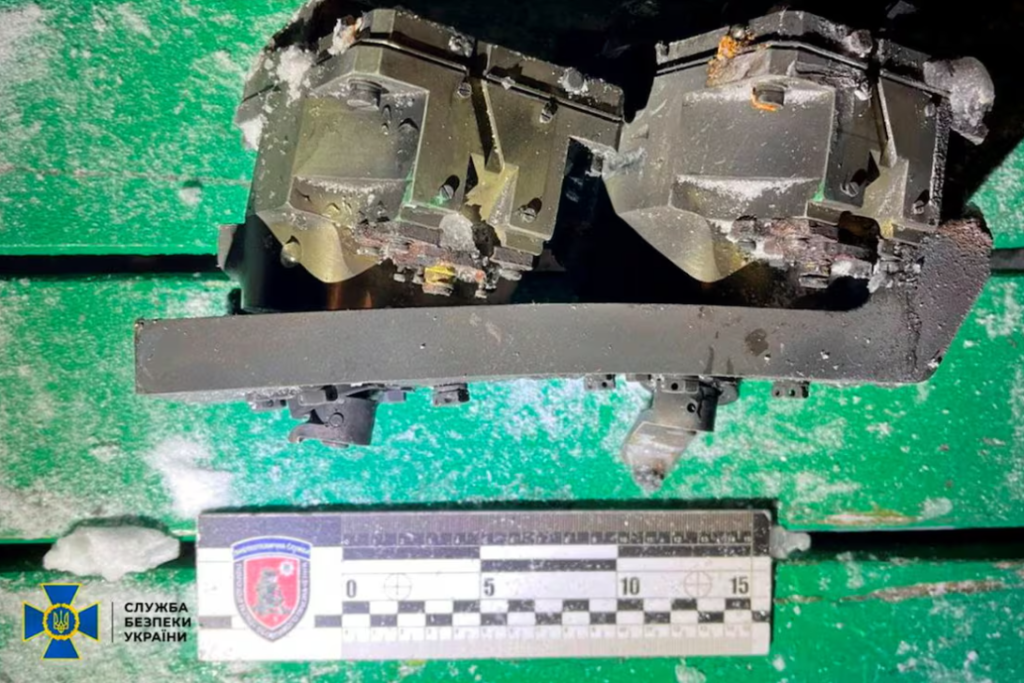
Experts say what differentiates the Oreshnik from other ballistic missiles being used by Russia against Ukraine is that it travels at hypersonic speeds and can be equipped with six warheads and submunitions which can be aimed at separate targets.
Marina Miron, a post-doctoral Researcher with King’s College London’s defence studies department says the weapon has three different phases.
The first is the boost phase, where it is launched and is thrust into space. She said this phase is estimated to last between two and four minutes.
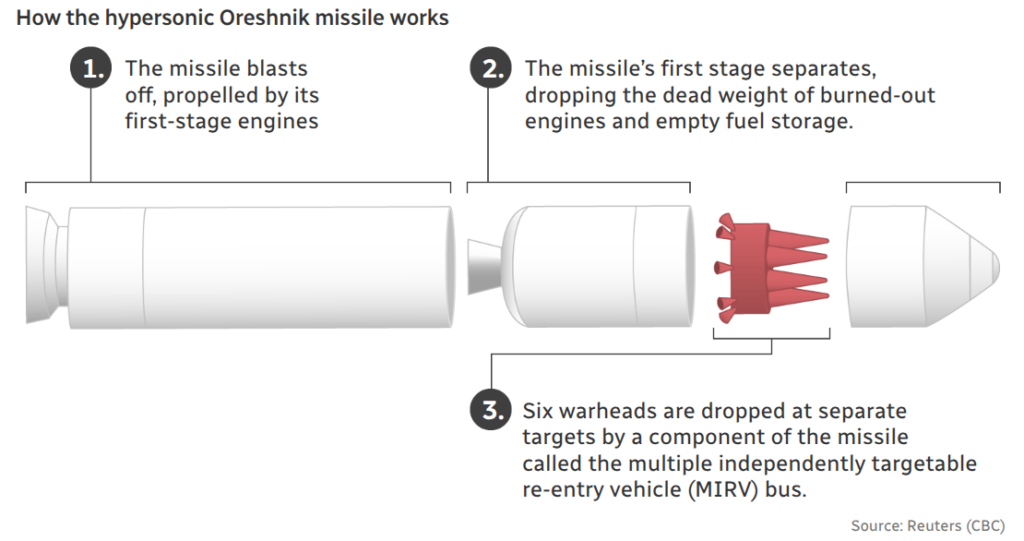
Once it is in space, part of the missile separates and falls back to earth, leaving a component called the Multiple Independently-targetable Reentry Vehicle (MIRV), to keep traveling through space, carrying the warheads.
In the third phase, the MIRV adjusts its trajectory before the warheads are released.
Given that each missile can carry six warheads, along with submunitions, Miron says it’s possible that “36 things could be falling from the sky.”
Can it be intercepted?
Experts, including Miron, say that it is impossible for Ukraine to intercept the Oreshnik, as it doesn’t have hypersonic interceptors, and it would be unable to target the weapon as it coasts through space.
When the munitions rain down, Miron says they could scatter over a wide area, making it extremely challenging.
“It’s like if I fire a round and the round is flying and you try to intercept it by throwing a stone,” she said in a phone interview with CBC News from Munich.
“You might be lucky, but the chances are close to zero.”
There have been reports that specific interceptor systems, which the U.S. and Israel possess, could theoretically intercept this type of missile, but Miron says their effectiveness needs to be tested.
“You would need to have layered air defense,” she said.
“But generally speaking, it’s very difficult to do anything against it.”
Why did Russia launch it now?
Reuters reported that an unnamed senior Ukrainian official said the Lviv Oreshnik was carrying inert or dummy warheads.
Many officials and defence experts believe Russia’s use of the weapon was designed to send a warning to Ukraine’s allies.
“I think this is a clear message directed at Trump, Macron, Merz and European leaders,” said the Lviv Mayor Andriy Sadovyi, in an interview with Reuters.
“The strike was effectively carried out on the border of the European Union. And a similar missile could reach European capitals in six to seven minutes.”
It’s unclear how many Oreshnik missile systems Russia has, although last year Moscow announced that it had dispatched some of them to Belarus, a key military ally for the Kremlin. Moscow has previously launched some of its attacks on Ukraine from Belarusian territory.
Glen Grant, a retired British lieutenant-colonel and defence expert with the Latvia-based Baltic Security Foundation, said it really makes no sense for Russia to use an expensive hypersonic weapon to target the types of infrastructure it has been successfully hitting with drones, and other missiles.
Instead, he believes it was used purely for political messaging.
“In other words, if we can fly it this far, we can fly it all the way to Warsaw or we can fly it to Riga, or we fly to Tallinn,” he told CBC News in a Zoom interview from Riga, Latvia.
“And of course, it is nuclear capable.”
By BRIAR STEWART/CBC