
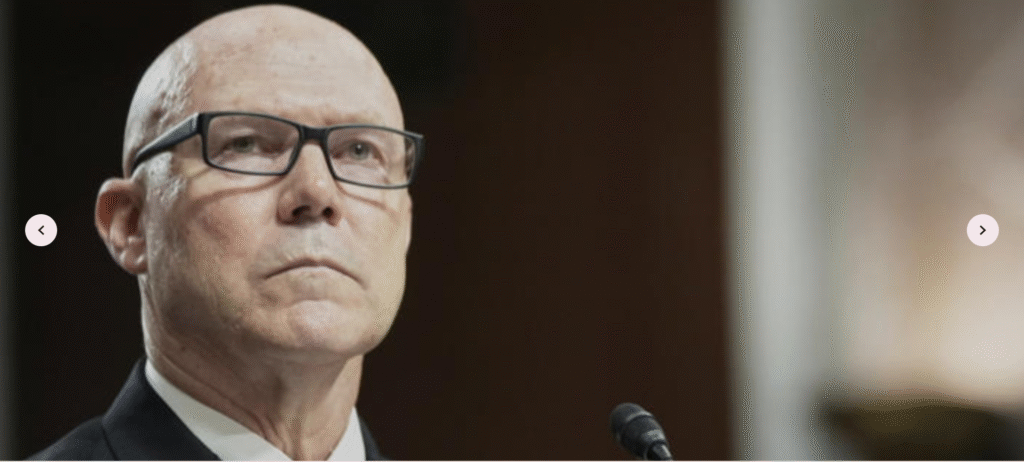

WASHINGTON—Two survivors of a Sept. 2 U.S. strike on an alleged drug boat in the Caribbean were killed in follow-up attacks after they were seen still aboard the damaged vessel alongside packages of illegal narcotics, a senior commander is expected to tell lawmakers today.
Adm. Frank “Mitch” Bradley plans to say he and his legal adviser concluded the two survivors were attempting to continue their drug run, making them and the already-damaged vessel legitimate targets for another attack, two defense officials said.
The details of the strike have emerged as a matter of concern for members of Congress who are seeking details about the role played by Bradley and Defense Secretary Pete Hegseth and whether aspects of the operation violated laws of war or Pentagon procedures.
The version of events Bradley is expected to deliver would rebut claims by legal experts that the killing of the two survivors could have constituted a war crime.
Lawmakers are likely to press Bradley, who commanded Joint Special Operations Command at the time, in the closed-door briefing on the extent of the damage to the boat, whether the men were injured, how Bradley reached his conclusions that the survivors were still legitimate targets, and whether he considered rescuing them.
The attack was the first use of military force against drug boats by the administration and the only one in which survivors are known to have been targeted and killed in follow-up strikes. In mid-October, the Coast Guard rescued two survivors of an attack on a submersible because they were deemed unable to fight, according to the defense officials.
The administration has launched 21 strikes in all, killing more than 80 people.
Many law-of-war analysts have criticized President Trump’s assertion that drug traffickers are terrorists purposefully killing Americans, rather than criminals providing illegal narcotics to willing buyers. They have homed in on whether the two survivors in the Sept. 2 attack should have been deemed out of action—and therefore no longer legitimate military targets.
The accounts of the attacks provided so far by the administration have left even some Republicans questioning the legality.
“There is a difference between being accused of being a bad guy and being a bad guy. It is called the presumption of innocence,” said Sen. Rand Paul (R., Ky.), often a critic of the administration’s national security policy. “It is called due process. It is called, basically, justice that our country was founded upon.”
Trump signaled support Wednesday for releasing the surveillance video of the operation taken by overhead aircraft.
Bradley was watching the live feed as the operation unfolded, the Pentagon officials said, as was Hegseth for part of the attack. The first part of the strike set the boat on fire and killed nine people, the officials said. It took an hour before the survivors were visible on the live feed, a third defense official said.
Bradley, in making his decision, considered that other “enemy” vessels were nearby and that the survivors were believed to be communicating via radio with others in the drug-smuggling ecosystem, the officials said.
If the boat was incapacitated and the men were unable to threaten U.S. military personnel, then the survivors would have met the definition of unable to fight, legal experts say. But if Bradley’s account is accurate, “it would appear to provide a legitimate explanation for the second strike,” said Geoffrey Corn, a former military lawyer who now directs the Center for Military Law and Policy at Texas Tech.
Officials said several contingencies had been built into the Sept. 2 plan, which Hegseth discussed ahead of the operation with Gen. Dan Caine, chairman of the Joint Chiefs of Staff, as well as intelligence analysts and other military aides. One of the scenarios included what to do if there were armed survivors.
“I support the decision to knock out the boats and whoever is piloting those boats” because “they are guilty of trying to kill people in our country,” Trump told reporters Wednesday. “You’re going to find that this is war.”
The boat turned around before the strike, which some experts say calls into question the administration’s claim that the traffickers posed an imminent threat to the U.S.
Hegseth confirmed Tuesday that he authorized Bradley to lead the operation and backed the additional strikes against the two survivors. “Adm. Bradley made the correct decision to ultimately sink the boat and eliminate the threat,” the secretary told reporters during a cabinet meeting alongside Trump on Tuesday.
Hegseth spent time ahead of the September 2 operation receiving input from Caine, as well as intelligence officials and other military aides about the vessel and the people in it, according to one of the officials. That process, which included a days-long intelligence gathering effort, ended with Hegseth authorizing the mission and giving Bradley command.
By SHELBY HOLLIDAY and ALEXANDER WARD/Wall Street Journal