
 John McCarthy
By: JOHN McCARTHY / V.I. Free Press News Reporter
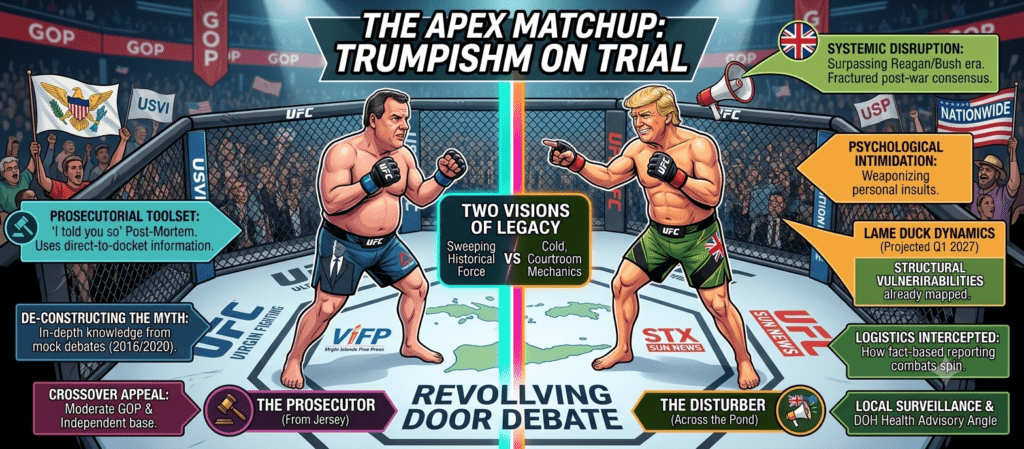
Two Visions of Legacy: The Transatlantic ‘Disturber’ vs. The Jersey Prosecutor
PART 1: ACROSS THE POND
The ‘Disturber’ Who Broke the Post-War Consensus
To observers watching from London—including historians like Dominic Sandbrook and Tom Holland on The Rest Is History—the American presidency is analyzed through a sweeping macro-historical lens. From that transatlantic distance, standard legislative skirmishes fade into the background, and systemic disruption takes center stage.
From the British perspective, Donald Trump will likely be remembered by history as a far greater “disturber” of the established order than any recent predecessor—surpassing the institutional legacies of Reagan, H.W. Bush, W. Bush, Clinton, Obama, and Biden combined.
Where past post-war commanders-in-chief operated strictly within established guardrails—preserving free-trade doctrines, NATO alliances, and traditional diplomatic decorum—the 45th and 47th President approached the global order as a system ripe for disruption. By weaponizing tariffs, openly questioning multilateral defense pacts, and challenging globalist norms, his legacy across the pond is viewed not as a standard presidency, but as a historic hinge point that fractured 80 years of post-WWII consensus. To international historians, whether one admires or despises the shift, the rules of global engagement were permanently rewritten.
PART 2: THE VIEW FROM NEW JERSEY
The Prosecutor’s Waiting Comeuppance
While transatlantic scholars track the macro shockwaves, domestic prosecutors and political strategists are watching the internal mechanics of a second-term lame duck. Chief among them is former New Jersey Governor Chris Christie, whose unique background makes him a lingering post-Trump threat.
Having sat directly across from Donald Trump as his primary mock-debate sparring partner in both 2016 and 2020, Christie holds an intimate, front-row understanding of the movement’s rhetoric and psychological triggers. He knows that the primary weapon of the movement has always been psychological intimidation—a tactic that loses its potency the moment an opponent refuses to flinch at rapid-fire personal insults.
Christie’s strategic positioning rests on three key pillars:
- The Lame-Duck Post-Mortem: As an administration enters its final phase, political movements inevitably face an accounting. Christie has deliberately built a public record positioning himself at the front of the line to say: “I warned you, I showed you the receipts, and I told you how this would end.”
- De-Constructing the Myth: Armed with the precision of a former federal prosecutor, Christie translates complex courtroom dockets into sharp, 30-second broadcast arguments. Because he speaks directly to moderate GOP and independent swing voters, his critiques threaten the exact crossover base needed to sustain long-term political power.
- The Immunity to Insults: The ongoing, personal jabs directed at Christie from national stages aren’t accidental—they are a defensive effort to discredit the messenger before his direct-to-docket legal arguments can take root with center-right audiences.
THE EDITORIAL BOTTOM LINE
When you place these two perspectives inside the same ring, the ultimate political paradox emerges:
Globally, history may well record Donald Trump as a singular, epoch-defining disruptor who shattered the post-war consensus. But back on domestic soil, that very disruption leaves behind structural stress fractures—leaving a former federal prosecutor waiting in the wings to dole out the cold, courtroom mechanics of a political comeuppance.
Listen to the British historical analysis that inspired our transatlantic perspective: The Rest Is History — American Presidents: The Invasion of Iraq, Obama’s Failures, and the Biden Blip
