
 John McCarthy
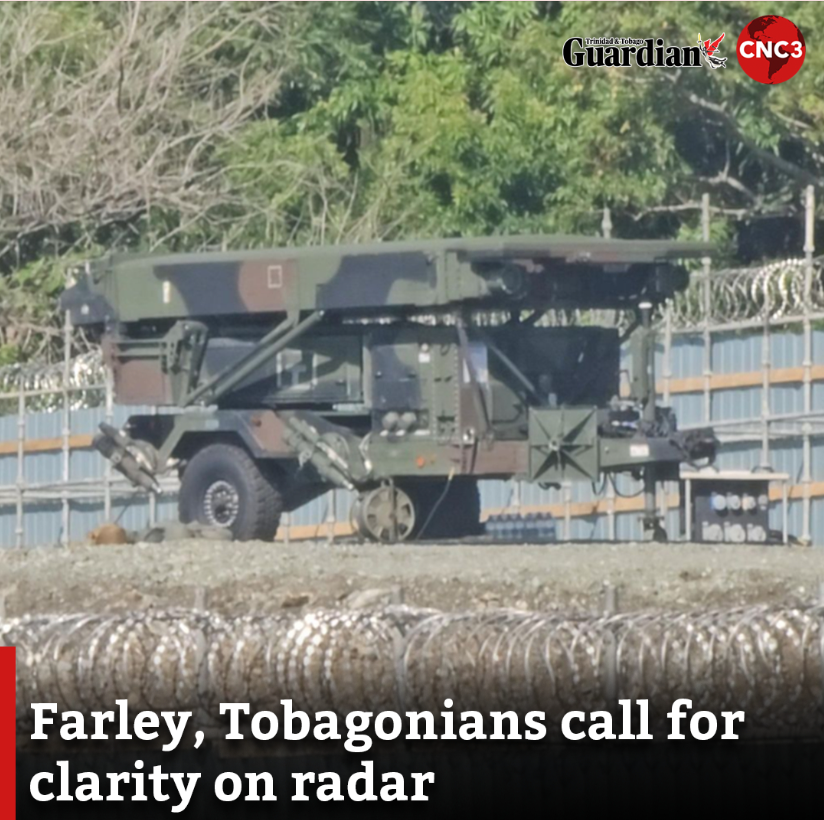
SCARBOROUGH— Trinidad and Tobago’s chief secretary has formally requested full details on the radar system being installed at the ANR Robinson International Airport in Tobago, the Trinidad and Tobago Guardian reports.
He has also asked for a dedicated meeting with Cabinet ministers and state agencies to explain the scope and purpose of the project, after confirming he was not briefed before the prime minister disclosed it publicly.
In a statement on Friday, the Office of the Chief Secretary said United States personnel have already begun work on a radar installation intended to “enhance surveillance capability,” but noted that Farley Augustine became aware of the development only after completing a live interview on Thursday night. The release said he learnt of the matter “only after” the Prime Minister announced it.
On Wednesday morning a US Air Force C-17A Globemaster III landed in Tobago just after 3 am.
According to the OCS, Augustine has since spoken with the Prime Minister and “requested full details on what is to be installed in Tobago.” A formal meeting is being arranged with relevant Cabinet ministers and agencies to clarify the purpose, scope, agreements and operational control of the radar system. The office said the public will be updated when those explanations are provided.
However, Tobago East MP David Joseph Thomas has taken a different position, saying he already has “good information” about what is happening at the airport and sees no cause for alarm. Thomas, a retired fire officer with 40 years in the service, said certain systems may appear unfamiliar to the public but are standard security requirements once an international airport is operational.
“I know the information is good information, and I know what is happening. It’s pretty normal,” he said. “When you’re not accustomed to things, it appears to be abnormal, and it brings about a cause for concern.”
Thomas said some aspects of the installation involve classified matters. “There are certain details, and there are events that need to be treated as classified,” he said.
However, former prime minister Dr Keith Rowley also commented on the issue, questioning how the installation could proceed without full awareness at the highest level.
“So foreign military aircraft could land at our airport in Tobago without the knowledge and consent of the Prime Minister, and once landed they could proceed to install a radar system, and the Prime Minister would only find out about this after because she thought they were there to build a road at the airport,” Rowley said.
He added, “I guess this is what the US President meant when he referred to us in the way he did. We are earning more of these epithets each day under this government.”
Political Leader of the Tobago Council of the PNM, Ancil Dennis, said the lack of prior consultation with the people of Tobago was unacceptable and said widespread talk about the radar had been circulating for weeks.
“It is unacceptable that Tobagonians have to learn these things after the fact,” Dennis said. “Where is the proper briefing? Where is the respect for Tobagonians?”
Dennis questioned how the Chief Secretary could insist he was unaware, given that multiple residents had raised the issue with him earlier.
“The first time I heard about any radar being built in Tobago was about two to three weeks ago,” he said. “People were talking about it… and all I could say is ‘I do not know’.”
He criticised the Chief Secretary for remaining silent on an issue where he would usually be outspoken. “The same Chief Secretary who at every opportunity, even for the most frivolous things, screamed disrespect, is silent today,” he said.
Dennis also raised questions about who controls the system, what agreements were signed, and why communities in Crown Point, Bon Accord and Canaan were not consulted. He said the public needs answers on environmental, safety and operational implications.
Augustine: media fear-mongering
But on Thursday night, Augustine, while speaking on a television programme, accused some in the media of driving unnecessary panic over the first US military aircraft, a C-17, landing.
“I see a lot of fear-mongering happening. I see a lot of journalists misconstruing facts.”
He said two things could be true — that the aircraft did refuel in Tobago, and that he was genuinely not briefed beforehand.
He said he intends to visit the airport personally. “I am going to go down to the airport myself and look at what they are building there,” he said.
Meanwhile, residents said the situation has become increasingly disruptive and unclear. Yesterday morning, Crown Point communities were again jolted awake by the arrival of a US C-17A Globemaster III — the third consecutive night of heavy, late-night aircraft activity.
Flightradar24 confirmed that a US Air Force C-17, registration 01-0192, departed Tobago shortly before 4 am and landed in New York around 7.40 am Tobago time.
“This is the third night in a row,” one resident said. “I keep jumping out my sleep. Why must the community be bothered at that hour of the morning?”
Another resident said the noise was unlike anything from commercial aircraft. “These planes coming in when everybody sleeping and leaving before dawn. It waking up the whole neighbourhood.”
Airport staff told Guardian Media a restricted zone has been set up for the installation of the radar. Workers said a structure “was put up in two days,” and another “shed” was completed in the last 24 hours. They were instructed not to enter the area or ask questions.
The developments come amid heightened regional tension between the United States and Venezuela and growing concern about the sudden appearance of foreign military aircraft in Tobago. The Prime Minister has confirmed the radar installation is underway, triggering calls for full transparency from both the central government and the THA.
Tobago Chamber: Business community unsettled
Chairman of the Tobago Division of the T&T Chamber of Industry and Commerce, Curtis Williams, said the business community is equally unsettled by the lack of information coming from officials.
“We are as surprised as all the Tobagonians that all these activities are happening on the island and no one is forthcoming with the information as to what is actually happening,” he said.
“We are all confused, and we are definitely waiting on the Prime Minister to say something positive because the speculation is bringing unease, and we really want everyone to be comfortable as to what’s happening in this space.”
The United States first pursued establishing a radar station in Trinidad and Tobago after Grenada first refused to host such a facility.
Here are the key details:
- Grenada’s Refusal: In early 1983, during the tenure of the New Jewel Movement government led by Prime Minister Maurice Bishop, the United States proposed constructing a regional military radar station in Grenada. This facility was intended to provide surveillance over the eastern Caribbean as part of the Regional Security System. Bishop’s government explicitly rejected the proposal, citing concerns over sovereignty and opposition to the perceived expansion of U.S. military influence in the region. This refusal was a significant point of contention in the deteriorating relationship between the two countries.
- Subsequent Agreement with Trinidad and Tobago: Following Grenada’s rejection, the United States successfully negotiated with Trinidad and Tobago to host the radar station. In September 1982, prior to Grenada’s outright refusal, Trinidad and Tobago had already agreed to allow the installation of a PAVE PAWS early-warning radar system. After Grenada declined to participate, Trinidad and Tobago proceeded with hosting the facility. Construction began in 1983, and the station, located at Mount Dillet in Chaguas, became operational in the mid-1980s.
This sequence of events is well-documented in historical accounts of U.S. security policy in the Caribbean during the Cold War. The radar station in Trinidad and Tobago was explicitly intended to fulfill the same regional surveillance role—monitoring potential Soviet air and missile activity—that the United States had originally sought to establish in Grenada.Supporting evidence includes:
- Statements from U.S. officials, such as those in the Department of State’s official justification for the subsequent military intervention in Grenada in October 1983, which explicitly cited Grenada’s refusal to permit the radar station as evidence of its alignment with Soviet interests.
- Scholarly works, such as Anthony Payne et al., Grenada: Revolution and Invasion (1984), which detail the failed negotiations over the radar site and the subsequent arrangement with Trinidad and Tobago.
- Declassified U.S. government documents, including diplomatic correspondence, which confirm that Trinidad and Tobago’s agreement to host the radar facility was pursued and secured in direct response to Grenada’s unwillingness to do so.
Thus, while negotiations with Trinidad and Tobago began independently and prior to Grenada’s definitive refusal, the operational decision to locate the sole regional radar station in Trinidad and Tobago was a direct consequence of Grenada’s rejection of the proposal. The radar station in Trinidad and Tobago effectively served the strategic purpose originally envisioned for Grenada, confirming that the United States established this facility in an alternative location after Grenada declined to host it.
The current radar station is at the PIARCO Airport in Trinidad. There is a reference to the TnT radar station in this episode of The Enforcer:
