 John McCarthy
By: Virgin Islands Free Press News Desk
ST. CROIX — When the Virgin Islands Free Press published a commentary breaking down the online reaction to a violent eviction dispute at 10 CB Estate Work & Rest, we highlighted the growing phenomenon of “Armchair Lawyers”—readers who replace statutory code with legal theories seemingly pulled from late-night television.
Predictably, the Facebook Court of Appeals immediately convened an emergency session in the comment section to file an appeal.
Despite clear reporting that a suspect was taken into custody after making death threats and striking a property owner in the presence of responding Virgin Islands Police Department officers, prominent commenters continued to assert that the arrest itself was illegal.
The theory? That a police officer witnessing a violent breach of the peace cannot make an arrest on the spot, but must instead pause the situation, consult the Attorney General, obtain an indictment under the U.S. Constitution, and advise the victim to file a civil lawsuit.
Because misinformation on law enforcement authority spreads quickly across social media, it is worth examining what actual Virgin Islands law says—and why “Facebook Law” would leave the territory in utter chaos.
The ‘AG Consultation’ Fallacy
One popular argument posted in the thread claimed that when a crime happens directly in front of a law enforcement officer:
“As a law officer you do not make an arrest! You consult with the A.G. And depending on the A.G. You get an arrest warrant if merited!”
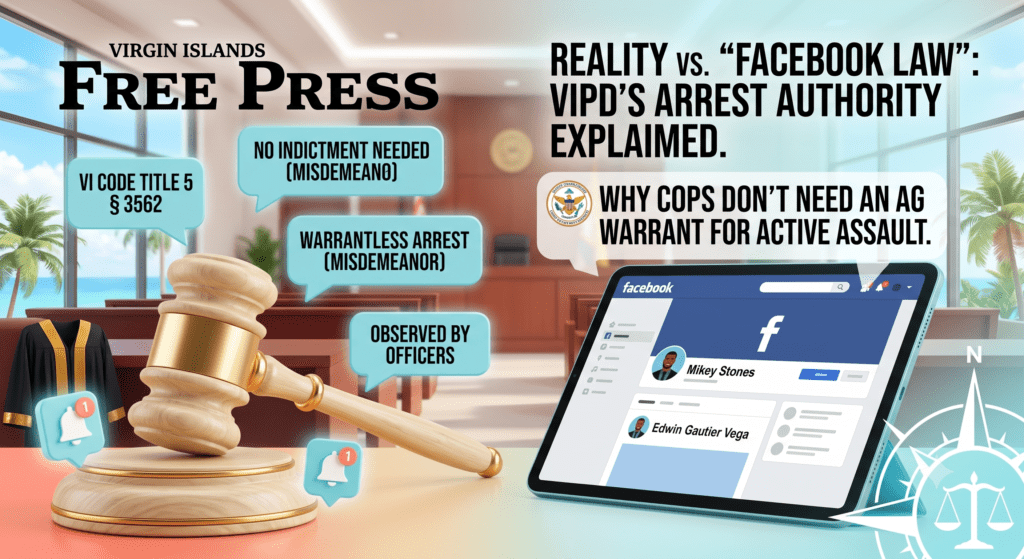
The Reality: Under Title 5, Section 3562 of the Virgin Islands Code, a peace officer is explicitly authorized to make an arrest without a warrant for any public offense committed or attempted in their presence.
If police officers were legally required to freeze an active physical altercation, pull out a smartphone, and hold a conference call with the Department of Justice before stepping in, law enforcement would be entirely decorative. When a violent crime occurs in front of an officer, immediate arrest is not just authorized—it is the officer’s fundamental duty to secure public safety.
The Grand Jury Indictment Confusion
Commenters also insisted in ALL CAPS that the arrest violated federal constitutional rights:
“Any arrests must be under indictments!!! The Constitution and Common Laws are being enforced… You must have an indictment as recognized under the U.S. CONSTITUTION!”
The Reality: This mixes up basic procedural steps in the justice system.
- Arrests vs. Indictments: An arrest is the initial restraint of a suspect based on probable cause. An indictment or information is the formal charging document filed in court after the investigation or arrest takes place.
- Misdemeanors: The Fifth Amendment requirement for grand jury indictments applies to capital or infamous federal felonies. For local misdemeanor charges—such as Simple Assault & Battery or Disturbance of the Peace by Threats—prosecutions in the Superior Court of the Virgin Islands proceed by an Information or sworn probable cause statement, not a grand jury indictment.
Suggesting that police need a grand jury indictment before cuffing someone who just struck a victim in plain view fundamentally flips the judicial process upside down.
Cops as Civil Litigation Advisors?
Perhaps the most creative claim fielded in the comment section was that instead of making an arrest, responding officers should simply:
“Advise the victim of their right to sue! Civilly.”
The Reality: The VIPD enforces criminal law, not civil tort disputes. While victims certainly retain the right to hire a private lawyer and file a civil suit for damages later, police officers called to a disturbance are tasked with stopping criminal acts, arresting offenders, and keeping the peace. Handing out civil attorney referral cards while an assault is taking place is not part of the VIPD protocol.
The Takeaway
Social media allows everyone to have a voice, but it also gives equal weight to legal fiction.
While the “Armchair Defense Team” continues to litigate the Estate Work & Rest arrest in the comment section, local law remains unchanged: if you threaten to kill someone and strike them in front of a VIPD officer, you will not be handed a civil lawsuit brochure or wait around for a court warrant. You will be handcuffed, transported to the John A. Bell Correctional Facility, and handed over to the actual judicial system.