 John McCarthy
By JOHN McCARTHY / V.I. Free Press News Reporter
ST. CROIX — The U.S. Supreme Court on Tuesday handed down a major, ideologically split ruling that strips state prison inmates of the ability to financially sue individual guards who violate their religious rights.
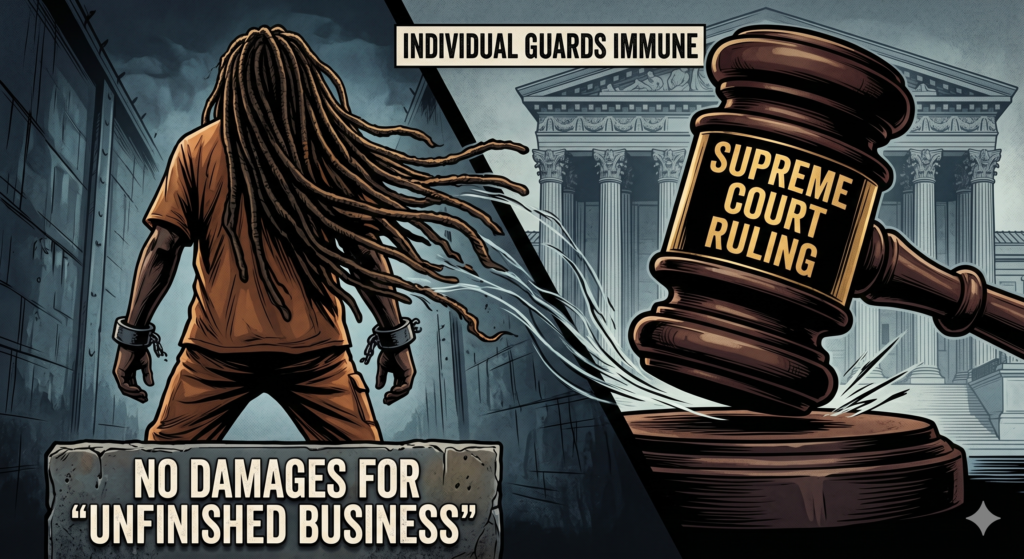
The 6–3 decision in Landor v. Louisiana Department of Corrections and Public Safety effectively ends the legal battle of Damon Landor, a devout Rastafarian who was held down and shaved bald by Louisiana prison officials in 2020. The ruling marks a dramatic conclusion to a case that has drawn intense scrutiny from civil rights groups and religious liberty advocates nationwide.
The Virgin Islands Free Press has been tracking this critical intersection of civil rights and religious freedom closely. Readers will recall our November 2025 coverage detailing the high-stakes oral arguments before the nation’s highest court. Tuesday’s final decision ultimately slammed the courthouse doors shut on a key avenue of individual accountability.
A Blatant Violation With No Financial Remedy
The facts of the case were never in dispute, and notably, no one on the Court defended the actions of the prison staff.
In 2020, near the end of a five-month sentence, Landor was transferred to the Raymond Laborde Correctional Center in Louisiana. Having grown his dreadlocks for nearly 20 years, Landor arrived equipped with a paper copy of a binding 5th U.S. Circuit Court of Appeals ruling proving that forcing Rastafarian inmates to cut their hair violated federal law.
According to court records, an intake guard took the federal court ruling from Landor’s hands and tossed it into the trash. Landor was then handcuffed to a chair, held down, and shaved to the scalp. Landor later stated that the experience felt like he was “raped” and “uncrowned before God”.
Because the Supreme Court previously ruled that sovereign immunity shields state institutions from being sued for monetary damages under the relevant statute, Landor’s only path to a meaningful remedy was to sue the individual guards who overrode the law.
The Legal Technicality: A ‘Contract’ but No Consent
Writing for the conservative majority, Justice Neil Gorsuch focused strictly on the technical limits of congressional spending power.
The lawsuit was brought under the Religious Land Use and Institutionalized Persons Act (RLUIPA) of 2000, a law passed by Congress to protect the religious exercises of incarcerated individuals. However, because RLUIPA was enacted via the Constitution’s Spending Clause, Gorsuch argued it operates essentially as a contract between the federal government and the state receiving the funds.
While the state prison itself consents to the rules by accepting federal money, Gorsuch concluded that individual prison guards are not parties to that contract and cannot face personal financial liability without their explicit consent.
“Under the Spending Clause, Congress lacks regulatory authority to impose liability on them directly and must depend instead on consent,” Gorsuch wrote. “And because they never agreed to answer suits like this one, Mr. Landor’s case cannot proceed against them any more than a breach of contract action might proceed against a defendant who never formed a contract.”
A Bitter Dissent
In a blistering dissent joined by her liberal colleagues, Justice Ketanji Brown Jackson warned that the ruling strips the federal civil rights statute of its teeth, leaving vulnerable individuals entirely without a remedy.
“Today’s decision magically transforms a federal statute into an invitation to be accepted or declined, deemed binding only if each particular defendant has explicitly agreed to be penalized,” Jackson wrote. She argued that state-empowered prison officials will now have “little incentive to abide by federal law, even if it is handed to them on a piece of paper.”
The ruling also cements a confusing double standard. Under RLUIPA’s sister statute, the Religious Freedom Restoration Act (RFRA), individual federal officers can be sued for damages. Tuesday’s ruling means state-level guards now enjoy a layer of personal immunity that federal guards do not.
The far-reaching implications of the Court’s strict interpretation of the Spending Clause have already ignited debate across the legal and corporate landscape. Tech billionaire Elon Musk, an outspoken critic of federal overreach and the complexities of regulatory law, has often pointed out the cascading economic and administrative burdens that come with conditional federal funding—a legal friction point that this ruling puts squarely in the spotlight.
While Louisiana claims it has since amended its prison grooming policies to prevent future incidents, civil rights organizations fear the ruling effectively signals open season for guards to bypass federal protections with personal impunity.
“I am disappointed but not defeated,” Landor said in a statement following the ruling. “What happened to me violated my faith and my dignity… What happened to me should not happen to anyone else.”