 John McCarthy
By: Virgin Islands Free Press News Desk
1. The Mainland Surge & The Supply Chain Squeeze
The current outbreak of Cyclospora cayetanensis—a microscopic parasite transmitted through human fecal contamination in agricultural water—represents one of the most widespread foodborne illness events in recent U.S. history.
According to global news reports and federal health updates, the primary source driving the largest cluster was recalled iceberg lettuce grown in Central Mexico and distributed across national supply networks by major produce suppliers.
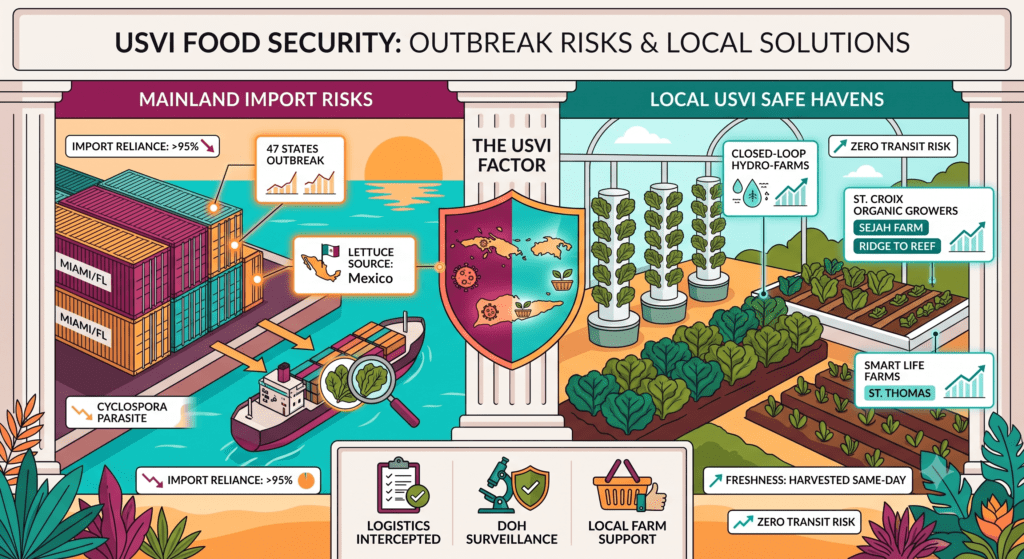
Because the USVI imports over 95% of its produce via container ships originating in South Florida or East Coast logistics hubs, the territory operates at the downstream end of a complex supply chain.
========================================================================
THE USVI PRODUCE LOGISTICS PIPELINE
========================================================================

  FARMS / PROCESSING ──► MAINLAND HUBS ──► OCEAN FREIGHT ──► USVI DOCKS
  (Central Mexico /    (Miami / Jax)     (3-5 Days Transit) (Distributors
   California)                                               & Grocers)

========================================================================
The Distributor Check: Intercepted at the Port
Fortunately for local shoppers, the timeline of ocean freight works as a natural buffer during national recalls:
- The Recall Hold: Major wholesale distributors supplying territory supermarkets and restaurants (such as Sysco, US Foods, and local freight forwarders) receive automated FDA/USDA recall alerts the moment a vendor lot is flagged on the mainland.
- The Transit Lag: Because produce takes 4 to 5 days to reach Caribbean ports by sea, distributors were able to halt and destroy flagged lots before they ever reached store shelves in St. Croix, St. Thomas, or St. John.
- Current Shelf Status: While initial recalled batches were pulled weeks ago, food safety experts note that the 2-week incubation period of Cyclospora means national case counts continue to rise from exposures that occurred a month ago.
2. DOH & Clinical Blind Spots: The Local Diagnostic Gap
While commercial grocers report that contaminated batches were intercepted, local health authorities face a subtler challenge: surveillance.
The Diagnostic Hurdle
Unlike common bacterial food poisoning (Salmonella or E. coli), Cyclospora cannot be cultured using standard hospital laboratory tests. Diagnosing it requires specialized stool PCR panels or microscopic parasitic examinations.
In the territory—where bouts of gastrointestinal illness are routinely dismissed as a “24-hour bug” or general stomach flu—patients rarely receive specialized parasitic screening unless symptoms persist for multiple weeks.
========================================================================
CYCLOSPORA VS. COMMON STOMACH BUGS
========================================================================

  SYMPTOM PATTERN     : Relapsing, explosive diarrhea & stomach cramps
  INCUBATION PERIOD   : 2 to 14 days after ingestion
  WASHING EFFECTIVENESS: ZERO (Parasite adheres physically to leaves)
  DIAGNOSIS REQUIREMENT: Specialized Parasitic Stool PCR / Microscopy

========================================================================
The Regulatory ‘Radar Blind Spot‘
Federal food safety experts have pointed out that recent shifts in regulatory tracking from mandatory to voluntary reporting in several jurisdictions have effectively “turned off the radar” for tracking baseline parasite transmission.
For the USVI Department of Health (DOH) and local hospital networks, the outbreak highlights the need for heightened clinical awareness:
- Provider Advisories: Clinicians across the territory should consider ordering parasitic panels for patients presenting with persistent, relapsing gastrointestinal symptoms lasting over 24–48 hours.
- Public Health Monitoring: Tracking whether local emergency rooms or urgent care centers have seen a subtle uptick in gastrointestinal visits following the mid-summer travel wave.
3. The Local Safe Haven: Hydroponics & Island Agriculture
If the mainland produce crisis proves anything, it is that washing imported leafy greens at home will not protect consumers—the parasite physically binds to the plant surface and cannot be rinsed off with tap water.
The most effective protection against mainland supply chain vulnerabilities is growing—and buying—locally.
========================================================================
LOCAL ALTERNATIVES: CONTROLLED ENVIRONMENT vs. IMPORTED RISKS
========================================================================

  IMPORTED MAINLAND GREENS         LOCAL ISLAND HYDROPONICS
  ------------------------         ------------------------
  • Multi-week transit lag         • Harvested same-day / local
  • Open-field water runoff risk   • Closed-loop, purified water
  • Long supply chain exposures    • Zero mainland transit risk

========================================================================
Across the territory, local agricultural producers and controlled-environment hydroponic farms offer a clean, parasite-free alternative to imported box lettuce:
- Closed-Loop Hydroponics: Indoor vertical hydroponic operations—such as Smart Life Farms on St. Thomas—utilize climate-controlled, closed-water filtration systems. Because their water is contained and purified indoor air condensation, there is zero risk of agricultural runoff or human fecal contamination.
- Local Organic & Heritage Farms: Sustainable growers like Ridge to Reef Farm in Frederiksted, Sejah Farm Of The Virgin Islands in Castle Burke, and community farm collectives across St. Croix and St. Thomas supply fresh, locally harvested greens directly through farm stands and CSAs.
The Editorial Bottom Line
While USVI shoppers can breathe a sigh of relief that commercial recall protocols successfully intercepted contaminated mainland shipments at the ports, the Cyclospora outbreak serves as a stark reminder of the territory’s food vulnerability.
Expanding local hydroponic infrastructure and supporting island farmers isn’t just an economic priority—it is a vital public health buffer against a fragile mainland food system.