 John McCarthy
By JOHN McCARTHY / V.I. Free Press News Reporter
The U.S. Virgin Islands is locked in a rare, high-stakes environmental and infrastructural crisis today as four distinct hazards converge simultaneously. A formal Heat Advisory and an official Fire Danger Statement issued by the National Weather Service highlight a dangerous multi-layered threat profile, where a dense Saharan Air Layer (SAL) plume has triggered extreme daytime heat and heightened wildfire risks, directly colliding with scheduled WAPA power grid shutdowns across St. Thomas and St. John.
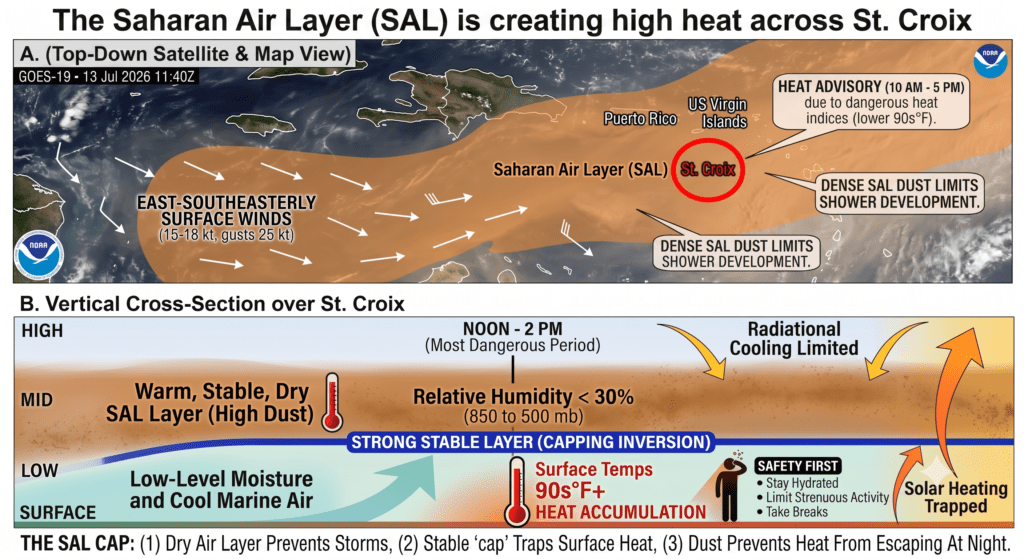
The immediate public safety challenge gripping the territory today stems from a singular, overwhelming atmospheric engine: a powerful Saharan Air Layer (SAL) tracking aggressively across the region.
The dense Saharan dust layer is actively creating heavily hazy skies, suppressing natural nighttime radiational cooling, and severely degrading regional air quality. Health officials have issued urgent warnings for vulnerable populations, advising individuals with asthma, severe allergies, or acute respiratory sensitivities to take immediate protective precautions and avoid outdoor exposure entirely.
Beyond the choking dust, the SAL is acting as a massive atmospheric blanket. By locking in low-level morning moisture and trapping intense solar radiation under a stable, dry air mass, the plume is driving local daytime temperatures to dangerous levels. The National Weather Service in San Juan has placed the U.S. Virgin Islands under a formal Heat Advisory from 10:00 AM to 5:00 PM today, with surface temperatures climbing well into the lower 90s across coastal and urban areas. The most critical, life-threatening exposure window is expected between noon and 2:00 PM.
The drying mechanics of the SAL have also systematically elevated the risk of rapid wildfire growth across the region. Global weather guidance indicates that the SAL’s intensely dry air mass has dropped middle-level relative humidity values below 30 percent, completely suffocating the development of rain showers. Driven by a tight local pressure gradient, easterly trade winds will gust up to 15 mph today. When combined with parched ground fuels and severe regional rainfall deficits, these conditions have forced an active Fire Danger Statement, with the National Weather Service explicitly designating St. Croix as a primary zone of concern for rapid wildfire growth.
The timing of this dust-driven environmental threat could not be worse for local residents. The Virgin Islands Water and Power Authority (WAPA) has chosen this exact window to move forward with planned, back-to-back power shutdowns across St. Thomas and St. John today and tomorrow. By cutting the power during the absolute peak hours of a dust-heavy heat advisory, the utility is stripping residents of air conditioning, fans, and filtration systems, leaving households fully exposed to the hazardous, hazy heat.
The optics of the planned blackouts have reignited intense local criticism regarding WAPA’s operational oversight and historic tone-deafness. While field crews are left to clear brush and manage a fragile grid under hazardous conditions, critics note that upper-level administrative brass seem more adept at organizing taxpayer-funded “educational boondoggles” to the cooler landscapes of the Midwestern United States than mitigating compounding crises at home.
With the outdoor air quality severely compromised by the Saharan plume, the tactical move for local residents today is clear: fold the outdoor plans and retreat. Staying inside an air-conditioned sanctuary is the only safe play on the board.